

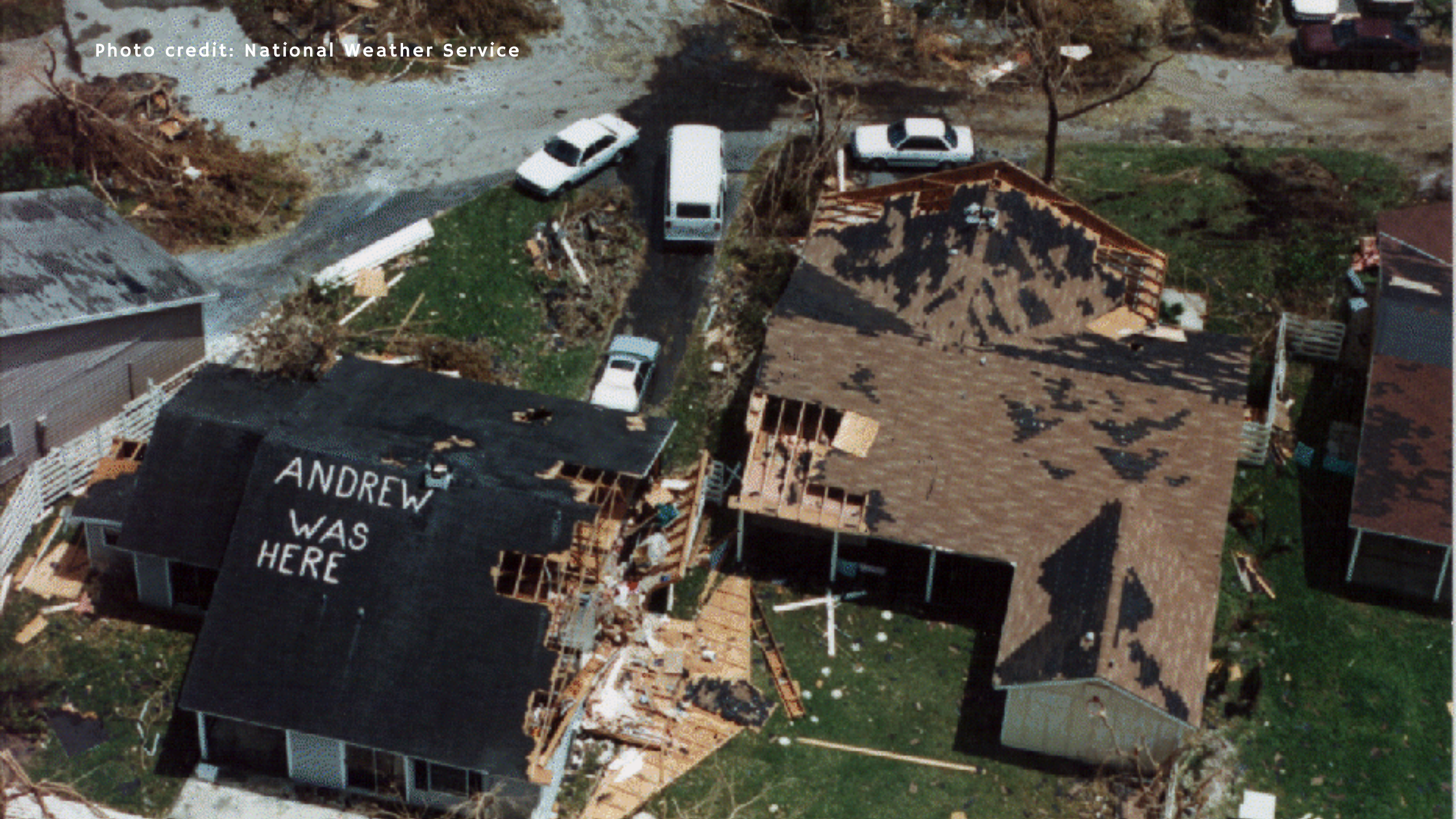
Two men, one family, one night on the same South Dade street, and the long displacement that followed.
By Denzel D. Burnside III, carrying a title and a witness from James S. Mullins.
A single essay for the anniversary. It braids my account of Hurricane Andrew with my late uncle’s, two witnesses to the same night on the same street, and then follows the storm into the thing it really was: a redistribution of who gets to live where, still running thirty-three years later. My uncle’s words are his own, drawn from his manuscript and quoted with permission.
“Through the storm.” James S. Mullins, 1992.
Thirty-thirty years ago this month, a storm taught a nine-year-old that the ground he stood on was not promised to him. I was that boy in South Miami Heights. What I did not know, and would not know until I found his papers, is that up the same street, in the house the whole family bent toward, my uncle James was writing the same night down as it happened, from a wheelchair, beside his mother, my grandmother.
We were all within a few doors of each other in South Miami Heights, close enough that a child could run between the houses barefoot before the streetlights came on. I rode the storm out in one house, nine years old. My uncle James and my grandmother were up the same street in another, close enough to shout to on a calm day, though there was nothing calm about that night. Everything I am about to tell you happened inside that one small stretch of a single street, which is why it has never felt like history to me. It felt like family.
Here is how my uncle began it.
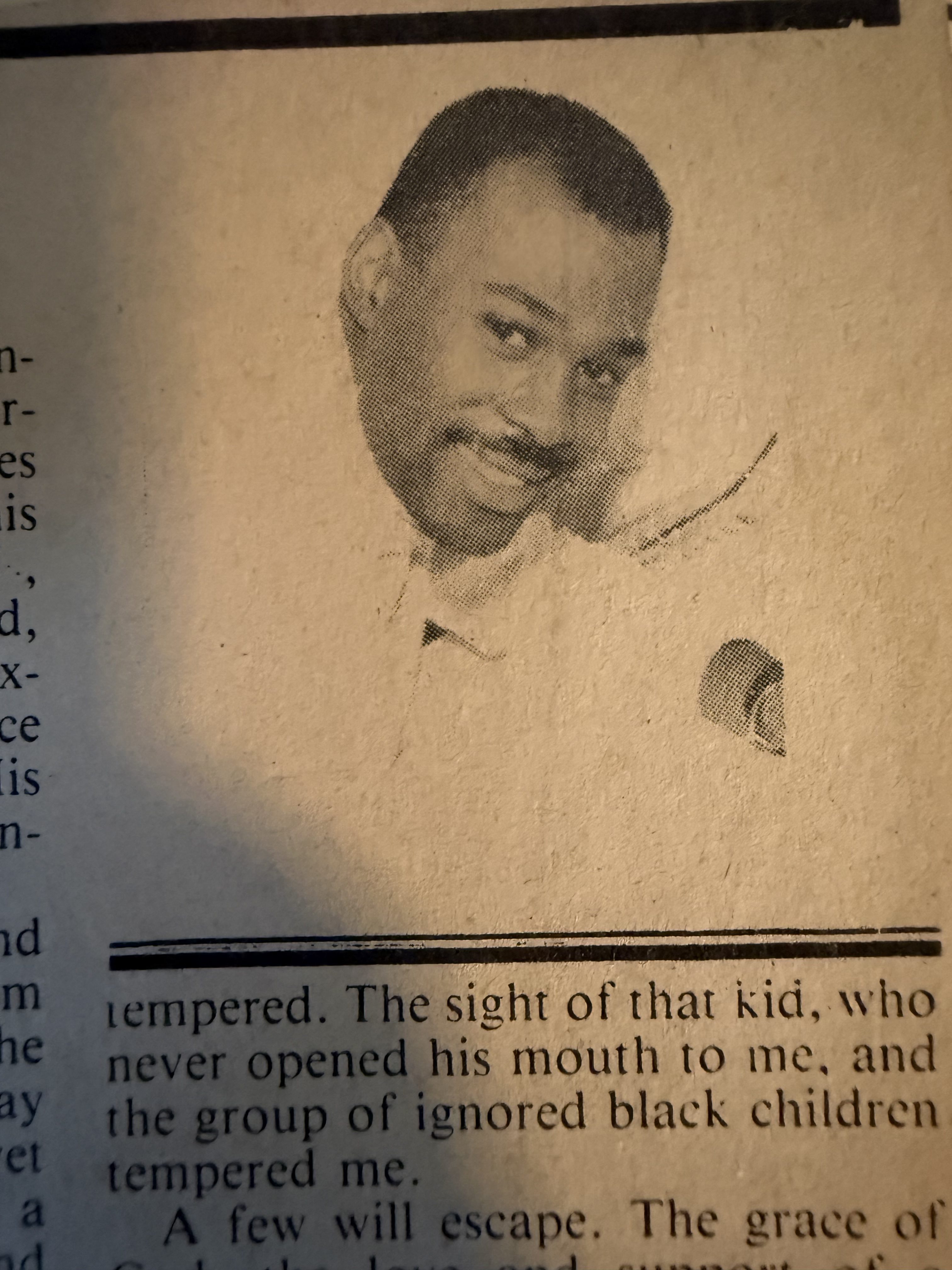
“Millions of Americans went to bed Sunday, August 23, much the same way as they had on any other given night, but not so for hundreds of thousands of residents in South Florida. For us, the impending threat of Hurricane Andrew storming our coast cast a heavy cloud of anxiety over the area, fueled by the uncertainty of what lay ahead. It had been some twenty years since the last major storm, and no one knew exactly what to expect. Well, we didn’t have to wait very long… for many of us, the longest night of our lives.”
He woke near eleven that night, he wrote, from “the most peaceful sleep I’d had in days,” and thought, in a mocking sort of way, that this must be the calm before the storm. Then he did the thing that tells you everything about where our family’s strength lives.
“Realizing that I should take some precaution, I called for my mother. Her name is Elloree, but I call her Weez or Weezie. To come so we could prepare a safe area for us to weather the storm. Ordinarily, I would have assumed that responsibility, but a recent illness had robbed me of the use of my legs”
A grown man, my uncle, the writer of the family, the one who taught me the craft I am using right now, calling down the hall for his mother because the storm was coming and his legs would not carry him to meet it. And my grandmother, Weezie, answered him the way she answered everything.
“Well, there’s nothing to worry about, darling,” she replied in a voice so sweet and soothing. “God has assured me that He won’t let anything happen to us.”
A few doors away, I did not have her calm. I was nine, a month shy of ten, about to start the fourth grade. I remember the bunk bed, and the power going out, and the wind howling like it had been possessed, like it was coming to claim souls. I remember a tractor-trailer lifted and thrown like a fistful of hay. I remember going to find my parents, both of them Miami-Dade corrections officers, braced in the living room behind plywood bolted over the windows, fighting the night the only way they knew. And I remember what pulled me down the hall to my sister’s room. I put my hand on the door, and it flew open, and three of the walls were gone, torn clean away, and the roar had dropped into an unnatural stillness. The eye was passing over us. I looked straight up into its calm, open center, as if the storm had come for our house alone.
Up the street, in that same passing quiet, my uncle and my grandmother were reaching the end of it.
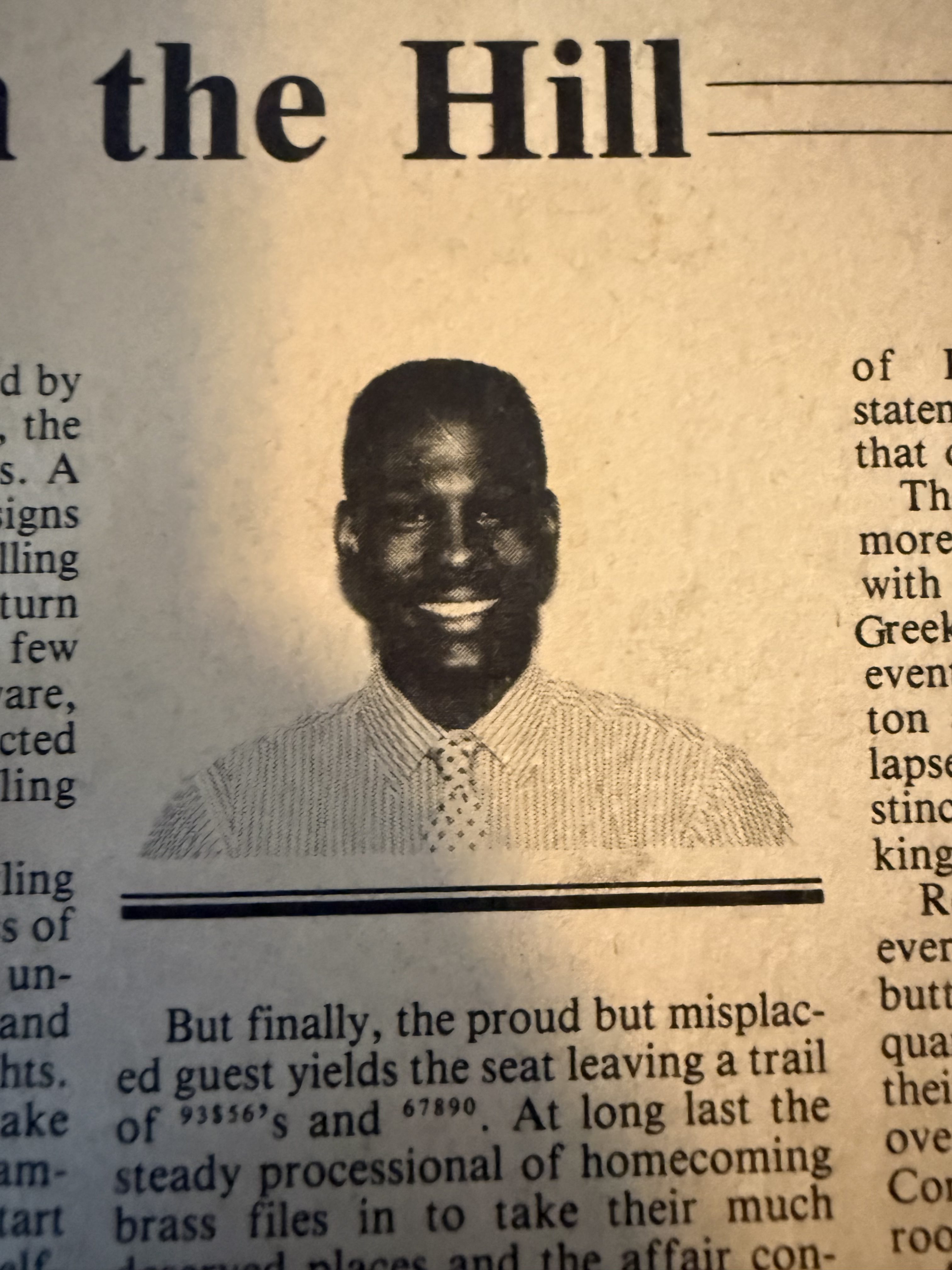
“That dreadful, shrieking noise, the kind that’s sure to return as the audio track for some terrible nightmare months later, had returned. Only this time… its force was so strong that it literally shook the house and even shook Weezie at least partly from her own foundation. ‘OK, Lord,’ she whispered. ‘I hear you; you’ve made your point. You can stop now.’ And within another half-an-hour, the storm had indeed given up its ghost and headed further south to wreak havoc on somebody else’s neighborhood.”
By morning, we were all counting what was left. My parents walked the block, checking on every neighbor. My uncle emerged to a house that would be unlivable for a month, and to a neighborhood, his sister’s among them, that he described in a sentence I cannot improve on.
“Many other people like my sister can’t claim the same. She and most of her neighbors emerged to find their once middle-class homes transformed into Beirut-like bomb shelters.”
We were sent north, my family, to my other grandmother, Marion, in Liberty City, across from Charles Hadley Park. We boiled water to bathe. We chased the ice trucks. We lived under a curfew enforced by the National Guard. For one terrible season, every Miamian lived the same story at once, Cuban and Haitian, Bahamian and Jamaican, white and Black, the newly arrived and the generations deep, all of us displaced together, all of us refugees again in the only country most of us had ever known.
And my uncle, from his chair, wrote the lesson down before any of us were ready to hear it.
“Maybe that’s the lesson to be learned from this tragedy, to remember that family and friends are what’s really important in life. In trying times, you need to be anchored to a solid foundation so that when strong winds blow, you won’t be blown away. My mother and I like so many were holding fast to God in our own way. Perhaps by taking us through the storm, God was reminding us that no matter how big we think we are, there’s a power greater than any one of us.”
Uncle James, I did not know until now that we wrote the same night. You set yours down from a wheelchair, up the street, while I was a boy a few doors away staring into the eye and thinking it was the sky clearing. It was not clear. It was the storm catching its breath before it came back the other way, and you knew that, and you wrote it down while I was still too young to understand what I had lived through. You were the writer of our family before I knew the family had one. So let me answer you late, the only way I can, by carrying your title and finishing the witness you started. The anchor you named held. I am living proof it held.
What the night began
My uncle wrote at night. I want to write about how the night began, because a storm does not only destroy homes. It redistributes who gets to live where, and that slower storm has been running ever since, on the same people, in the same neighborhoods.
Start with the wound in numbers. On August 24, 1992, Hurricane Andrew came ashore near Homestead as a Category 5, 165 miles an hour. It destroyed more than 25,000 homes and left more than 160,000 people without one. In Homestead, more than 99 percent of the mobile homes were gone. Florida City lost roughly 60 percent of its tax base in four and a half hours. More than 100,000 residents moved north and did not come back, and the county lost tens of thousands of people that year.
Watch where they went. Thousands of us, tired of chasing Red Cross trucks and waiting on a rebuild that crawled, took the insurance money and left for good, and the county to our north was ready. What had been a cow pasture and dairy farms, Pembroke Pines, Miramar, and Davie, became, almost overnight, a suburban metropolis fed by our exodus. Pembroke Pines alone went from about 65,000 people in 1990 to more than 150,000, and was ranked in 1999 as the third-fastest-growing city in America. Our loss became their boom. The storm emptied one place and filled another, and the market called it growth.
And the promise of a real rebuild, the transit and the investment that could have stitched South Dade back into the body of the county, never came. That is the through-line I have spent my life’s work on, and it is the thesis my uncle’s anchor points straight at: housing, transportation, and the environment are not three problems. They are one. Where a family can afford to live, whether they can get anywhere from there, and whether they can survive the next storm are the same question asked three ways. Solve them apart, and you fail at all three.

Photo credit: https://uml-mosaic.org/
The slow storm
There is a fast way for the water to displace people, and a slow way. The fast way is Andrew. The slow way has a name now: climate gentrification, and it works like this. As seas rise and floods repeat, money learns which ground is safe. Investment flees the low coast for the higher, drier ground, and it turns out the higher ground is where the poor and the Black were pushed generations ago, when the waterfront was the prize. So the value inverts, and the people who held that ground through every year of neglect are priced out of it just as it becomes worth defending. You can watch it in Miami right now. Little Haiti sits about seven feet above sea level, higher than the glittering coast, and so the developers have come. A billion-dollar project called the Magic City Innovation District is rising in the middle of it, and Harvard research that named climate gentrification found that Miami-Dade home values are already climbing fastest on the higher ground, the exact mechanism that prices the poor off the land they were once pushed onto. The same water that took my family’s house by force is taking Little Haiti’s by appraisal.
Years later, I followed my own life out of Miami to North Carolina, where I now lead a statewide housing coalition, and I found the same machine running a thousand miles north. The coast learned Miami’s lesson in 2018, when Hurricane Florence sat over Wilmington and dropped more than 26 inches of rain on a rental market that was already too tight before the water came. The wind writes the headline. The housing market writes the sentence. And the mountains, sold for years as a climate haven, learned it in September 2024, when Hurricane Helene walked into western North Carolina and proved there is no such place, killing more than 200 people across the Southeast and over 100 in North Carolina alone, dozens of them in Asheville’s home county of Buncombe, in a rainfall scientists put close to a one-in-a-thousand-year event. A real estate scholar named Jesse Keenan said the truest thing I have read about any of it: there is no such thing as a climate haven, only sending zones and receiving zones. And after the water goes down, he said, the wealthy come in and buy the cheap land—first the flood, then the appraisal, then the sorting of who gets to come home.
Set them side by side. Miami in 1992, Wilmington in 2018, the mountains in 2024. A coast, another coast, a supposed refuge. Three regions, one machine. In every case, the water destroyed homes; in every case, the destruction became a redistribution; and in every case, the people with the least were sent somewhere more dangerous. In contrast, the people with the most bought the safer ground that the poor had been holding all along.
The philosopher T. M. Scanlon put the whole of morality in one test: that we owe one another treatment we could justify on grounds the other could not reasonably reject. Hold our climate policy up to that test. Tell the family in Homestead, Wilmington, or Swannanoa that the market will decide where they may live now, and that the higher ground they held is needed by someone who can pay more for it. That is not an answer they could accept, and it is not one we could justify. It is just what happens when we treat home, the way to it, and its defense against the water as three problems for three departments instead of one covenant among neighbors.
I run a housing coalition now, and Andrew is under everything I believe about what a just rebuild requires. It comes to this: you cannot plan the house without planning the way to it and its defense as one thing. A home is not just walls. It is the road that reaches it, the transit that frees the family inside it, and the seawall, the code, and the insurance that let them stay when the water comes. We keep rebuilding in pieces, a house here, a road someday, a promise later, and the storm keeps finding the seams. A rebuild protects people in place before the wind, not after, and it treats the home, the journey, and the defense as a single sentence. That is all that thirty years and one hurricane taught me.
The anchor
My uncle wrote that you have to be anchored to a solid foundation so that when strong winds blow, you will not be blown away. He meant God and family, and he meant it from a chair the storm could have taken. I have spent my life learning that a county can be an anchor, too, or the wind. It can build the trail to the home and the seawall that keeps a family rooted, or it can study them for forty years and let the next storm do the sorting. The choice is not the weather. The choice is ours.
So here we are, the boy in the eye and the man in the chair, up the same street, thirty years apart, both bent over the same night trying to make words hold what the wind tried to take. He named an anchor in his account, and the anchor held, for him, for me, and for a family that is still here to tell it. But I keep thinking about the ones the water does not let stay, the ones moved out of South Dade and out of every low place since, quietly, by storms and by policies that behave like storms. The Scripture my uncle would have reached for says hope is an anchor for the soul, sure and steadfast. I believe that. And still I have to ask the question his account left me, and that mine leaves you. When the water keeps moving our people, what do we owe the ones it moves, and when will we finally build a shore that lets them stay?
In memory of James S. Mullins, who wrote the first “Through the Storm“ from a wheelchair in 1992, and whose title and witness this essay carries with the family’s permission.

Denzel D. Burnside III is a Miami-Dade native, a minister, and a former organizer and campaign manager. He is the founder and executive director of the North Carolina Housing Table, a statewide housing coalition, where he works on housing and transportation policy.
Hy-Lo News encourages community members, thought leaders, social commentators, experts, and really ANYONE to submit commentary expressing their opinions and sharing their points of view. The views they express in their Op-Eds are their own, but we believe in the right to provide people a platform to share them. However, we will never condone or publish hate speech, violence, bullying, or anything our editorial team deems problematic.
To submit your Op-Ed, email us at info@hylonews.com.
0 comments on “OP-ED | Through the Storm: A Reflection on the 34th Anniversary of Hurricane Andrew”