


The CD-20 breakdown: the numbers, the split, and how Debbie Wasserman Schultz won a majority-Black seat
Part two of two. Part one, “The Throne Hastings Left,“ is the reckoning: the legacy, the meaning, and what this costs. This is the math. Fairness note: Sheila Cherfilus-McCormick is indicted, not convicted, and denies the charges.
“Forty-five percent beat fifty-five percent, because fifty-five percent could not agree on a name.”
An operative who will not read the numbers is just a fan with an opinion. So here is exactly how the Alcee Hastings seat left Black hands on August 18, laid out so you can see it, not just feel it.
The result
Debbie Wasserman Schultz won the Democratic primary in Florida’s 20th with about 45 percent of the vote, roughly 30,000 ballots. Dale Holness finished a distant second with nearly 23 percent. Elijah Manley took about 14 percent. Sheila Cherfilus-McCormick, the former incumbent, came in under 10 percent, and Luther Campbell finished behind her. Add the four Black candidates together, and they drew about 55 percent of the vote in a majority-Black district, yet still lost the seat because that 55 percent was split four ways, while the 45 percent was not.
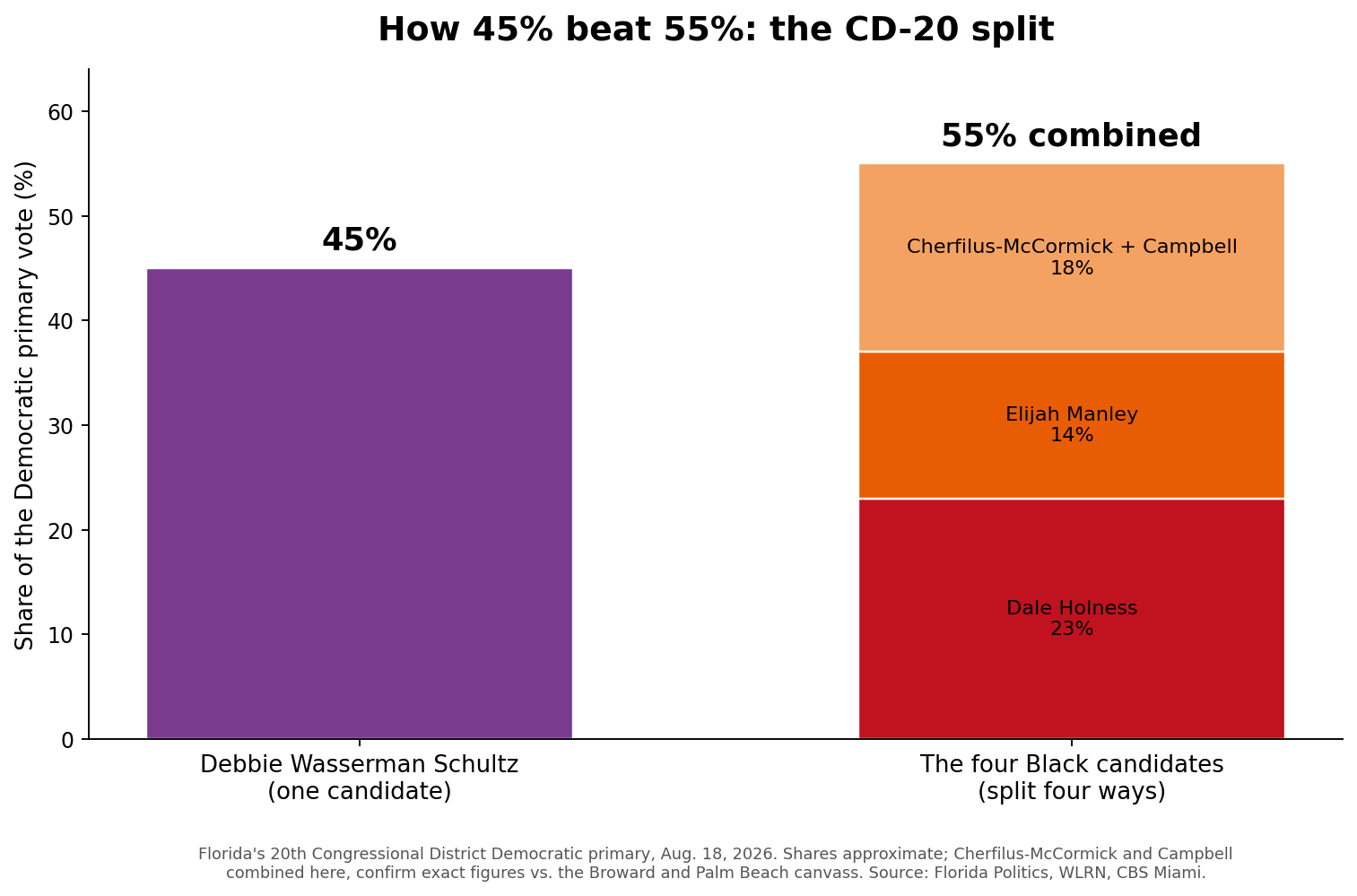
How 45 percent beat 55 percent. Wasserman Schultz won 45 percent as the sole candidate; the four Black candidates drew about 55 percent combined, splitting it four ways: Florida’s 20th Congressional District Democratic primary, August 18, 2026. Shares are approximate; confirm against the canvass.
Why the split is fatal: how a plurality primary works
Most people arguing about this can’t define the thing at its center, so let me explain the machine, because the machine is the story.
Florida’s 20th is rated the most Democratic district in the state, which means the August Democratic primary is the real election and November is a formality. And Florida runs a plurality primary: there is no runoff. Whoever gets the most votes wins, even with far less than half the votes. You do not need a majority. You need one more vote than the next person. So when several candidates from the same community split that community’s vote, none of them has to be rejected by voters for all of them to lose. They only need to be preferred by fewer people than the one candidate who isn’t splitting anything. That is not a theory. It is arithmetic, and this district has already lived it once.
In 2021, when the seat first came open, Cherfilus-McCormick won the special primary by five votes, 11,662 to 11,657, while nine other candidates split more than 25,000 votes between them. Five votes, because the field would not consolidate. The district watched a crowded Black field nearly hand away its own power once, and then, five years later, did it again, except this time the person who walked through the gap was not one of its own.
The map of the split
The geography is the argument. Wasserman Schultz did not win by converting Black voters. She won by consolidating the part of this redrawn district that used to be hers, the whiter, older, more established Broward precincts folded into the 20th when the maps moved, where she has represented these same voters for two decades and enjoys near-universal name recognition. Meanwhile, the Black-plurality precincts of central Broward and Palm Beach, the historic heart of this seat, were divided: Holness here, Manley there, Cherfilus-McCormick and Campbell splitting the rest. One bloc voted as a bloc. The other bloc voted as four.
The breakdown, candidate by candidate
| Candidate | Share | Who they are | What the number means |
| Debbie Wasserman Schultz | about 45% | Eleven-term white incumbent, redrawn out of the 25th and into the 20th | Won by consolidating one bloc while the other split four ways |
| Dale Holness | about 23% | Former Broward mayor, first Jamaican American to hold the office; lost the 2021 special by five votes | The strongest Black finisher, and still 22 points back |
| Elijah Manley | about 14% | Twenty-seven-year-old teacher and activist who beat DeSantis in court in 2021 | Real energy, not enough base |
| Sheila Cherfilus-McCormick | under 10% | The former incumbent, resigned amid a federal indictment she denies | The scandal collapsed her, and incumbency did not save her |
| Luther “Uncle Luke“ Campbell | single digits, behind Cherfilus-McCormick | Hip-hop legend and free-speech pioneer turned high-school coach | Name recognition without a turnout machine |
Now read it as one story. If a single Black candidate had consolidated even half of what the other three candidates won, this seat would remain Black. Holness at 23 was the closest, and had he been the lone standard-bearer, the math flips on contact: 23 plus 14 plus the Cherfilus-McCormick and Campbell votes is a comfortable majority over 45. That is not a hypothetical. It is subtraction. The votes existed. They were spread across four names rather than gathered under one.
How Debbie won
She won the way an incumbent with money and history wins a fractured field, and it came down to three things. First, name recognition. She has been on a South Florida ballot for two decades, and every voter in the redrawn precincts knew her, while the Black field was four less-established names competing for the same attention. Second, consolidation. Her old Broward base moved into the 20th when the maps changed, and it voted for her as one of them. Third, and most telling, she saw the split coming and counted on it. Florida Politics reported months before the vote that four Black candidates were dividing the vote and that Wasserman Schultz was banking on exactly that. She never needed a majority. In a plurality primary with no runoff, she only needed to be the one name nobody was dividing, and she was.
The proof is one district south.
Suppose you want to see that the split, and not just the map, is what did it, look at the 24th on the very same night. It was supposed to be the prepared seat. Frederica Wilson timed her retirement until after the maps were locked, leaving a named heir, Commissioner Oliver Gilbert. And with a seven-way primary, Gilbert won. Oliver Gilbert beat Jones 34.5 percent to 32, with Kendrick Meek Jr. taking 17—two points, because the field fractured seven ways. Hold the two districts side by side. In the 24th, the split was Black-on-Black, so the seat stayed in Black hands even as the prepared succession failed. In the 20th, the split allowed a candidate from outside the community to win the plurality: same disease, two outcomes. We would not consolidate.
The general and what it locks in
Florida’s 20th is the most Democratic district in the state, so November is a formality. Wasserman Schultz will face a Republican, Brent Andersen, and an independent, Kedner Maxime, in a district that Democrats carry by 30 points or more. Barring something unexpected, she is going to Congress. The nomination was not a way station. It was the seat. And if she is sworn in, the Hastings seat, one of only two majority-Black congressional districts left in Florida, will be represented by someone from outside the community it was drawn to empower, and the state’s Black congressional representation drops toward a modern low. The general will ratify what the primary has already decided.
The seat is up again in two years. The maps we cannot fully control, and the money we cannot match. But the discipline to close ranks behind one name before the polls open has always been ours to give or to squander. The numbers say we squandered it. The numbers can also say something different in 2028.
Read the companion piece, “The Throne Hastings Left,“ for what this seat means and what its loss costs.

Denzel D. Burnside III is a Miami-Dade native, a minister, and a former organizer and campaign manager. He is the founder and executive director of the North Carolina Housing Table, a statewide housing coalition, where he works on housing and transportation policy.
Hy-Lo News encourages community members, thought leaders, social commentators, experts, and really ANYONE to submit commentary expressing their opinions and sharing their points of view. The views they express in their Op-Eds are their own, but we believe in the right to provide people a platform to share them. However, we will never condone or publish hate speech, violence, bullying, or anything our editorial team deems problematic.
To submit your Op-Ed, email us at info@hylonews.com.
Pingback: OP-ED: The Throne Hastings Left and The Reckoning of CD-20 – Hy-Lo News