

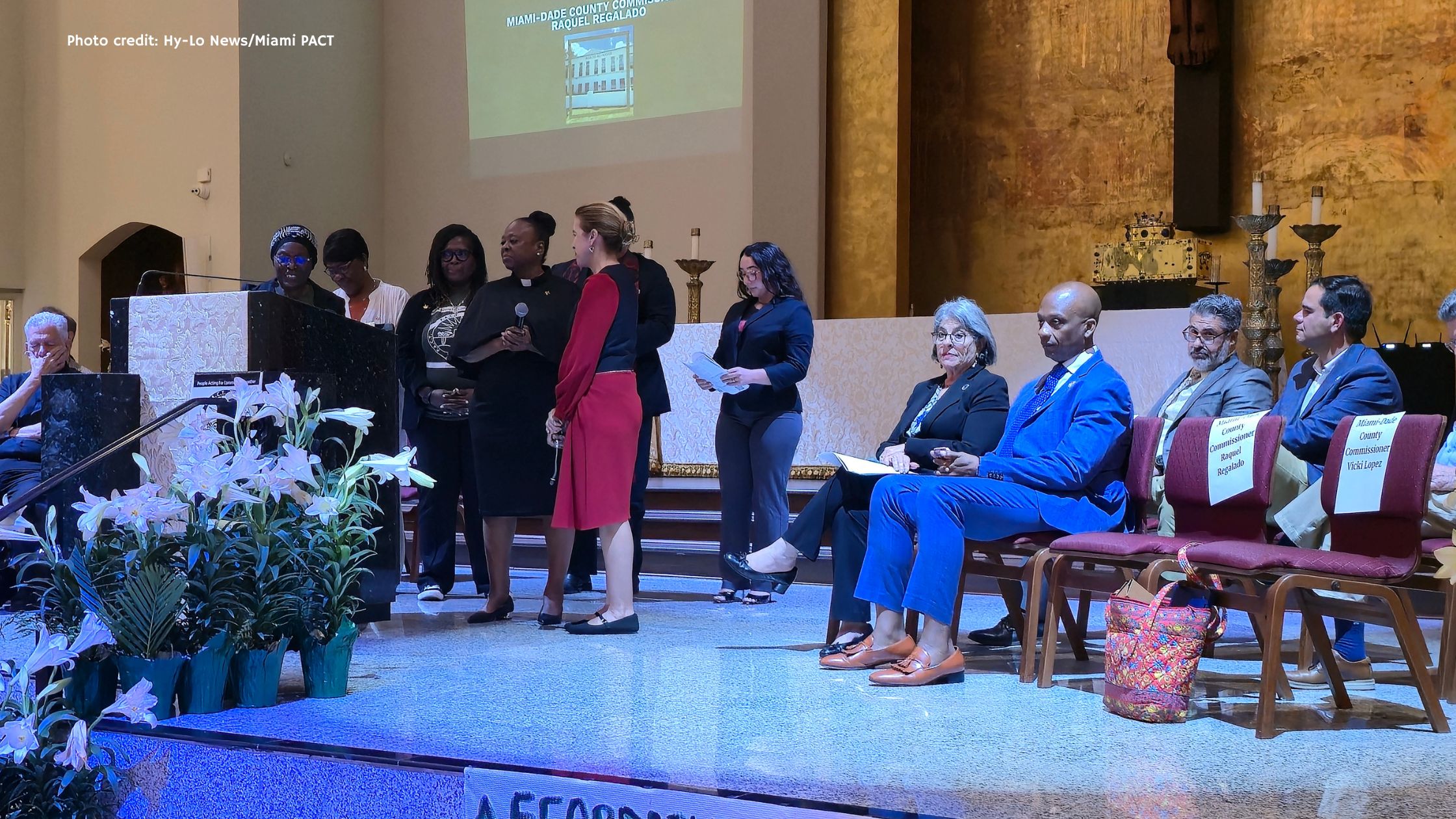
A high-stakes annual assembly organized by a coalition of local faith leaders erupted into a tense showdown last month. The “Nehemiah Action” assembly, held by Miami People Acting for Community Together (Miami PACT) at Corpus Christi Catholic Church, is an annual event named after the biblical prophet who held rulers accountable for the suffering of their people. The event brought face-to-face demands to South Florida’s top elected local leaders, drawing a crowd of passionate community members.
While some proposals garnered broad support, the room grew adversarial over the metrics used to fund affordable housing.
As reported by WLRN, Miami PACT urged officials to fundamentally alter how affordable housing is calculated in Miami-Dade County. The group demanded that the county amend its code to calculate Area Median Income (AMI) by individual census tracts rather than a countywide average. They also pushed to cap the definition of “workforce housing” to individuals and families earning below 100 percent of the AMI, arguing the current countywide metric skews housing prices too high for the region’s lowest-income residents.
When explicitly asked from the podium if he would support county legislation to incorporate census tract and neighborhood-level income data into the evaluation framework within a 90-day window, Miami-Dade County Commission Chairman Oliver Gilbert III rejected the immediate timeline.
“I’m supportive of those,” Gilbert told the vocal crowd, referencing the concept of neighborhood data. “I think the trickery was within 90 days. I need to fully understand what those changes will have as far as unintended consequences.”
Gilbert emphasized that because AMI metrics are tied to federal standards, making rapid local modifications could disrupt the broader development ecosystem.
“So I’m hearing, your issue is only in the timeline,” an organizer countered, pointing out that the underlying conversation was fundamentally about resolving the housing crisis.
While Gilbert explicitly stated he would be willing to agree to the policy framework six months down the road to allow for proper evaluation, he refused to give in to the 90-day pressure of the assembly.
“Changing AMI… might have some consequences that I’m not willing to commit to right now,” he added.
Advocates contend that the status quo is unsustainable. With the countywide median tracking near $99,100 for a two-person household, current rules allow workforce housing initiatives to target individuals making up to 140 percent of that benchmark. Leaders from Miami PACT point out that this framework skews development incentives away from those who need it most, inadvertently pricing out working-class families in favor of higher earners.
Despite the friction over housing timelines, the assembly yielded a major breakthrough on another long-standing front: a commitment to finally fund the Center for Mental Health and Recovery. The diversionary facility, designed to treat incarcerated individuals experiencing homelessness and mental illness rather than keeping them behind bars, was approved by voters in 2004 but has sat idle for decades due to lack of funding.
The breakthrough came via a concrete legislative proposal put forth by Miami-Dade mayor Daniella Levine Cava and Commissioner Raquel Regalado to fund the center’s operations using a two-year nonprofit pilot program.
Unlike the housing initiative, Gilbert promised he would fast-track this proposal and vowed to vote in favor of it at the next commission meeting. Miami City Commissioner Ralph Rosado also committed to advocating for municipal funds to support the facility’s long-term operation.
0 comments on “Commissioner Oliver Gilbert Pushes Back on Miami PACT’s 90-Day Housing Demand Amid Debate Over What ‘Affordable’ Means in Miami-Dade”