

Mentorship and Early Support Systems are Key to Closing the Gap
In Miami-Dade County, the path to economic mobility starts well before college. It begins in early childhood classrooms, moves through K-12 schools, and continues into higher education institutions, where access, support and opportunity come together.
While higher education can help people move up in life, data from Opportunity Insights at Harvard University Mobility Report Cards shows that access alone is not enough. Not all schools, and not all students, benefit equally.
To function as a true ladder to upward mobility, institutions must both ensure broad access for diverse students and provide the support necessary for them to succeed. One without the other, researchers note, is not enough to contribute to economic mobility at large.
Access vs. Outcomes
The mobility report cards measure how effectively colleges move students up the income ladder.
The data reveals a gap: Highly selective universities produce strong outcomes for low-income students but enroll very few of them. Meanwhile, community colleges enroll a greater number of low-income students, but fewer reach top income levels.

At University of Miami (UM), the median family income is $146,600. Only 3% of students come from families earning $20,000 or less, and fewer than 2% move from the bottom 20% to the top 20% of earners.

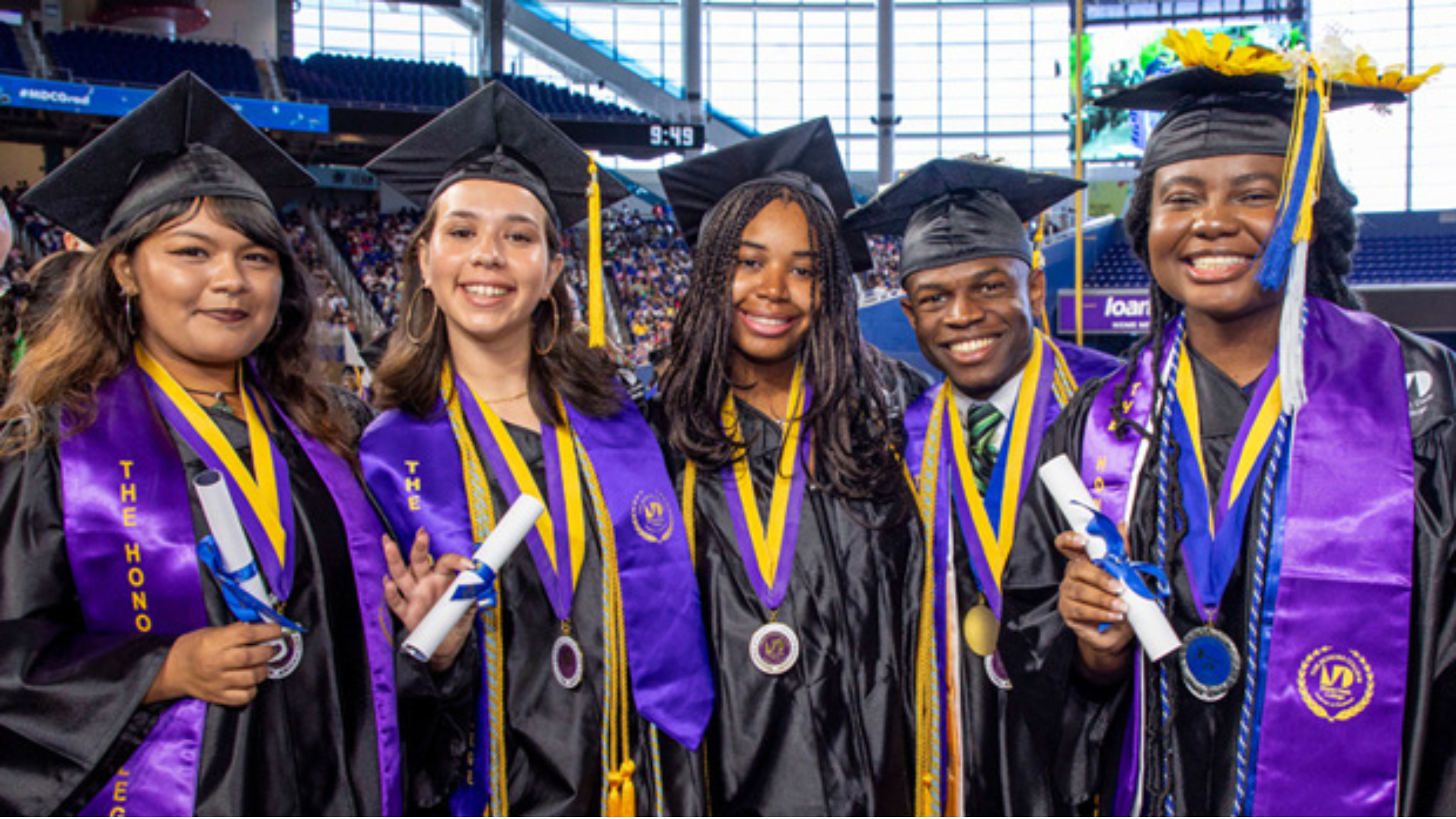
In contrast, Miami Dade College (MDC) is one of the most accessible institutions in the nation, ranking fifth among peer institutions for enrolling students from the lowest-income bracket. Its median student family income is $31,600, with nearly 29% of students from the bottom quintile.
“Miami Dade College is democracy college,” said Dr. Malou C. Harrison, MDC’s executive vice president and provost. “MDC is the institution in our community that has an open door to all who seek an education to advance themselves and their families and contribute to the community.”
But access alone does not guarantee high earnings.
According to the report cards, by age 34, MDC graduates have a median income of $31,300. While 36% move up at least two income levels, only 4.6% reach the highest income group.

The Role of Community Colleges
MDC’s open-door policy supports mobility through flexible pathways, including stackable workforce certificates and credit for prior learning. The college prioritizes completion, transfer and workforce outcomes, awarding over 20,000 credentials last year.
“We are not developing new programs for the sake of it because they sound good,” Harrison said. “We’re doing it because there’s an economic development and workforce development need.”
Recognizing that many students balance school with work and family, MDC provides extensive support: childcare, emergency aid and proactive advising. The results are measurable: MDC ranks fourth out of 68 comparable colleges for overall economic mobility, with 90% of workforce program students securing jobs, often before graduation.
“MDC’s education is propelling students to social mobility through a career — not a job, but a career,” Harrison said, noting the institution’s $5.8 billion economic impact on the region.

(Courtesy of Miami-Dade College)

(Tri-Star Leadership)
Where the Gaps Begin
Many barriers to mobility begin well before the first college application. Dr. Steve Gallon III, a Miami-Dade County Public Schools (M-DCPS) board member, notes that the trajectory is often set before kindergarten.
“The hard work is done at the early childhood level,” he said. “Marginalized children are always playing catch-up. They come in behind children in affluent communities who have private daycare, nannies who read to them, and parents with the resources to provide high-quality early learning.”
“Equity recognizes that all children don’t start off at the same point, and all children don’t need the same thing,” Gallon added.
To address this, M-DCPS partners with the Early Learning Coalition and The Children’s Trust to expand programs. These early gaps compound over time, affecting test scores and access to selective universities.
Test Scores and Other Barriers
Opportunity Insights data shows that low-income students are less likely to achieve the standardized scores required for elite institutions, largely due to disparities in resources.
Gallon challenges the weight placed on standardized testing.
“I don’t believe those tests should be the sole indicator of a student’s ability to succeed,” he says, suggesting colleges consider soft skills, motivation and interpersonal skills.
He points to his own journey: His initial scores didn’t meet Florida A&M’s threshold, but he was admitted through a probationary program. Three years later, he graduated Magna Cum Laude, eventually earning advanced degrees and completing postdoctoral work at Harvard and Stanford.
“If we were to determine that initial SAT/ACT as a barometer with respect to my preparedness for college, that would have been something that would have kept me out of the game,” he said.
Even with sufficient test scores, low-income students attend selective colleges at lower rates. High-income students are 34% more likely to attend elite colleges than low-income peers with the same performance, showing family income still shapes opportunity.
Middle-class students also face unique hurdles. While low-income high-achievers are often recruited through diversity programs and financial aid, middle-class students may lack both the financial resources and the targeted institutional support to compete for elite seats.
“Systemic issues linger. We have some institutions that have a finite number of seats, and their commitment to diversity, equity, and inclusion is not always what it can be,” Gallon said. “It’s a very competitive landscape, and very often, the middle class doesn’t have a leg up sometimes as it relates to students’ preparation on the quantitative test.”
Beyond admissions, students face hurdles such as limited knowledge of the application process and lack of access to test preparation.
To counter this, M-DCPS has expanded mentorship, internships and real-world learning experiences, including financial literacy programs.
“We understand that in many homes, our children don’t have the exposure. Some students don’t even believe they have the financial capacity to attend college,” Gallon said. “You can’t make the shots that you don’t take, and too many of our students don’t take a shot.”

(School Board Member Dr. Steve Gallon III via Facebook)
How Mentorship Fills the Gap
Mentorship programs are helping bridge these gaps by providing guidance, exposure and confidence.
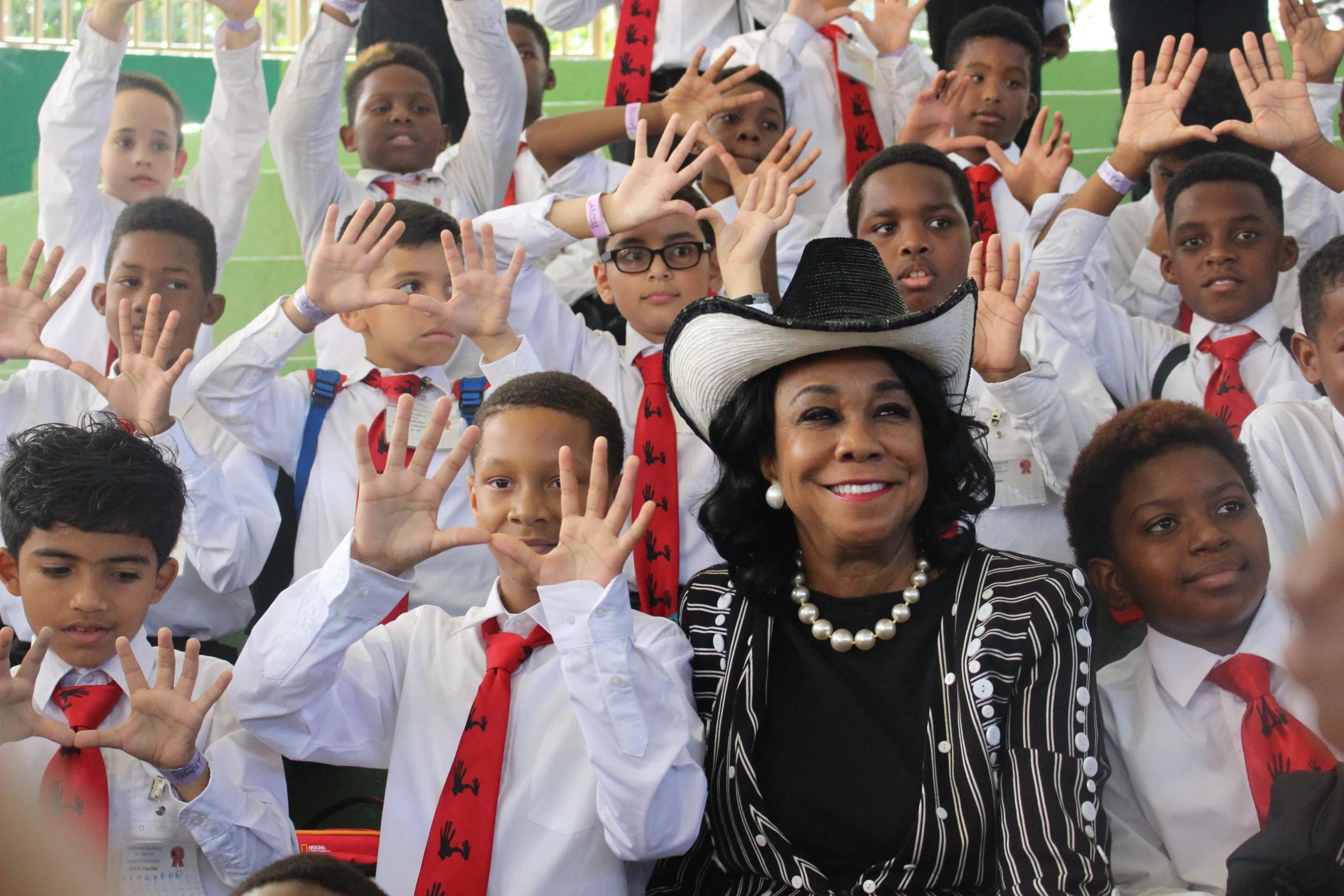
Congresswoman Frederica S. Wilson founded the 5000 Role Models of Excellence Project in 1993 after seeing too many “boys being labeled by society before anyone even took the time to guide them.”

“Children do not fail because they lack talent. They fail when no one shows up for them,” Wilson said. “Mentorship gives them role models, structure and a belief in their potential before tragedy strikes.”
For Wilson, mobility means a child’s “zip code does not define the future.” Through the program, students are guided toward higher education, vocational training and broader opportunities.
(Courtesy of Obama Foundation)
That impact is reflected in students like Semaj Gilliard, a 19-year-old from Goulds, now a freshman at Howard University. He first encountered the program as a child, watching Black professionals, doctors, lawyers and elected officials pledge to mentor young boys.
“To see these Black professionals standing on the stage,” Gilliard said, “that really instilled in me a different meaning of success.”
As he progressed through school, mentorship became a constant. Weekly grade checks and college prep support shaped his academic path and confidence. Through the Wilson Scholars program, Gilliard traveled to Washington, D.C., toured Howard University and connected with Miami-Dade Commissioner Kionne McGhee, a Howard alumnus who helped guide Gilliard’s college journey.

(Courtesy of Semaj Gilliard)
“My dream school has always been Howard University, the Mecca, the African-American Harvard,” Gilliard said. “I had viewed Howard as out of my reach, even though I had great grades.”
According to Howard’s mobility report card, about 4% of students at Howard came from poor families but became rich adults.
Today, Gilliard studies physics, supported by scholarships that ease the financial burden.
“Since I’m going out of state, I’m not going basically for free, but I am getting a pretty good stipend for my tuition, which definitely takes away a lot of the barrier when it comes to financials,” he said, noting that the Wilson Scholars program helps students cover in-state tuition by supplementing aid after FAFSA and scholarships are applied.
More than anything, though, he said the program provided the “safety net” needed to reach for his goals.
“We’re all able to fly, but it’s that hitting the ground that’s really scary,” Gilliard said. “To know that the 5000 Role Models program is all behind you, it really just emboldens you to go for it and see what you can do.”

(Courtesy of Semaj Gilliard)
Beyond the Classroom
Meanwhile, organizations like Big Brothers Big Sisters of Miami are scaling workplace mentorship to bridge the “social capital” gap for students with talent but no professional networks. President and CEO Gale Nelson Jr. argues that mentorship is an economic engine.
“Mentorship allows businesses to invest, recruit, retain and reap the rewards,” Nelson said, citing research from the U.S. Treasury and Harvard showing a three-to-one return on every dollar invested in such programs.

(Amelia Orjuela Da Silva for The Miami Times)
The organization’s School to Work program helps corporate brands “flex their citizenship muscles” by pairing students with professionals like JPMorgan Chase Market Director Yvette Castro.
For students, entering a high-rise office can be daunting.
“You’re talking about high school students being in a room full of adults,” Castro said.
For 19-year-old Alanys Bustamante, the exposure she gained from Castro was a “game changer.” Originally planning to become an EMT, she shifted to business after seeing the “world of opportunity” at the firm. Now an associate banker at JPMorgan Chase, she sees the program as her gateway.
“I don’t think I would be here without my mentor. She helped me learn what business actually is,” Bustamante said.
This reporting was produced in partnership with The Miami Times and supported by Hy-Lo News through a grant from the Local Media Association & Comcast.
This article is part of a national initiative exploring how geography, policy, and local conditions influence access to opportunity. Find more stories at economicopportunitylab.com/ .

Sign up for our weekly email newsletter and watch our weekly LIVE podcast news show every Thursday at 5:30pm. Subscribe to our YouTube page to get alerts for the show.
0 comments on “Why College Access Isn’t Enough to Boost Economic Mobility in Miami-Dade”