

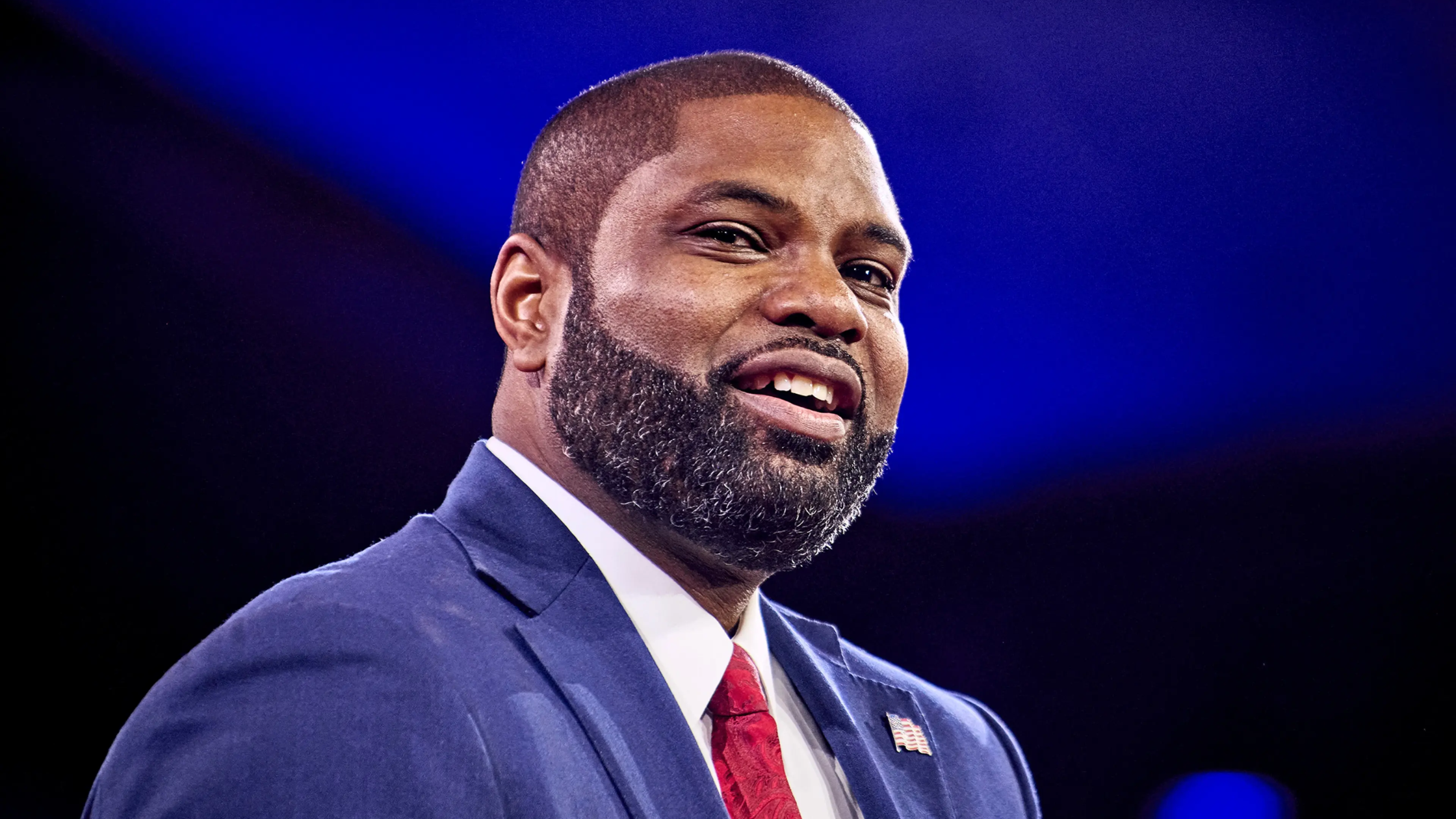
Byron Donalds is the first Black man Florida’s Republican Party has ever put at the top of its ticket. The history is real. So is the fine print.
A standalone companion to my four-part Florida governor series. The series traces the whole field; this piece keys in on one man, the history he just made, the math of his race, and the hard question underneath both. A note on language: this piece quotes racial attacks made against Donald by his own primary rival.
On August 18, 2026, Byron Donalds won the Republican nomination for governor of Florida and, in doing so, became the first Black man his party has ever placed at the top of a statewide ticket in this state. If he wins in November, he will be the first Black governor in Florida history. That is real, and I am not going to be too proud or too partisan to say it plainly. A Black man from Southwest Florida is one election from the governor’s mansion, and whatever comes next, that fact belongs in the record.
But a first is not the same as an arrival, and the honest story here lives in the gap between the two.
The symmetry nobody in the party wants to name
Start with the history, because the history is stranger and sharper than the celebration lets on. Donalds is not the first Black person Florida has ever nominated for governor. He is the second. The first was Andrew Gillum, in 2018, a Black Democrat who came within about a third of a percent, roughly 33,000 votes, of the mansion, and lost to Ron DeSantis in the closest governor’s race in modern Florida history.
Sit with that sequence, because it is the whole story in three names. Gillum, the first Black nominee and a Democrat, nearly wins but is beaten by DeSantis. DeSantis then spends eight years building the most aggressive conservative machine in the country. And now that machine’s chosen heir, the second Black man Florida has ever nominated for governor, is a Republican running to continue it. The same movement that beat the first Black candidate by a hair and then governed for eight years in ways that thinned Black political power is the movement carrying the second Black candidate to the brink of office. That is not a triumph of racial progress. It is something more complicated and more uncomfortable, and it is the thing this piece is about.
The race, by the numbers
Let me lay out the math the way I laid out the field in the series, because the data tells you where this stands.
Donalds won his primary in a walk. He carried Donald Trump’s “complete and total” endorsement, and it decided the race before it started. The most revealing part was who he beat: Jay Collins, the sitting lieutenant governor handpicked by DeSantis, turning the Republican primary into a proxy war between the two most powerful Republicans in the country. Trump backed Donalds. DeSantis, term-limited and unwilling to bless the man Trump chose, backed Collins. Trump’s man won. The president overrode the governor and picked his own successor in the governor’s own state.
Here is the primary in the actual numbers. Donalds took about 47.8 percent of the Republican vote, winning by roughly thirty points, though just shy of a majority in a crowded field. Collins finished a distant second at nearly 18 percent. The former House Speaker Paul Renner took about 8, and James Fishback, the investor who spent the race calling Donalds a “slave” and a “DEI Republican,” finished at about 4.
| Republican candidate | Share | Who |
|---|---|---|
| Byron Donalds | about 47.8% | Naples congressman, Trump’s pick |
| Jay Collins | about 18% | Lieutenant governor, DeSantis’s pick |
| Paul Renner | about 8% | Former Florida House Speaker |
| James Fishback | about 4% | Investor who racially attacked Donalds |
There is a small, cold justice in that last line. The man who called the Black frontrunner an enslaved person and mocked his name as “By’rone” finished at four percent. The movement did not punish the degradation, but the primary electorate did not reward it either.
Behind the win sits a fortress. Donalds has raised more than $103 million, including a $10 million contribution from Citadel billionaire Ken Griffin to his affiliated committee. His Democratic opponent, David Jolly, a former Republican congressman who won the Democratic nomination with about 60 percent of the vote, has raised a small fraction of that. The money gap is more than 10-to-1.
And still, the one number that measures November says it is a race. The University of North Florida poll had Donalds ahead of Jolly 46 to 41, about five points, in a state Trump carried three times. Five points, with that money and that endorsement, in a state this red, memeanonalds is the clear favorite,ot a lock. He is running downhill. He is not running unopposed.
The fine print: alignment
Now the hard part, the part the celebration skips, because you cannot understand Byron Donalds’s candidacy without understanding the movement he is the face of and what that movement has done.
He is running as the standard-bearer of the Florida Republican Party in the DeSantis era, the same era that redrew the state’s congressional map to thin Black voting strength, that blocked the College Board’s Advanced Placement course in African American Studies from Florida high schools as “indoctrination,” that fought the teaching of race in classrooms and the books on the shelves. Florida has only two majority-Black congressional districts left, and this very summer one of them slipped away. The machinery Donalds would inherit is the machinery that spent eight years making Black political power smaller. He is not a bystander to that project. He is its nominee.
And here is the detail that turns alignment from an abstraction into a wound. Donald’s own party did not spare him the very thing the movement traffics in. His most aggressive Republican primary rival, the investor James Fishback, spent the race calling Donalda “slave” to his donors, mocking his name as “By’rone,” branding him a “DEI Republican,” and describing a Black vision of the state as “a Section 8 ghetto.” He ran an ad whose entire premise was the sentence “Byron Donalds is Black.” It was so plain that even David Jolly, the Democrat, called it what it was: racist.
Read that carefully. A Black man runs for governor as the champion of a movement, and a white rival inside that same movement calls him a slave. It reduces his whole candidacy to his skin, and the movement mostly shrugs because the degradation was never what it minded. This is not the opposition doing it to him. This is the house. And a house that will use a slur against its own frontrunner is telling you something about what it actually values in him, and what it does not.
The fair reading, because he has earned one
I am not going to give you the lazy version of this argument, because it insults the man and it is beneath the work. Byron DDonald’sambition is his own, earned, not handed to him. His conservatism may be entirely sincere. It is condescending, and I will not do it, to treat every Black Republican as a dupe who does not know his own mind or cannot hold his own convictions. Grant all of that, at full strength.
And then make the only turn that matters. Sincerity was never the question. A movement can want everything a man provides, his face, his story, his usefulness as living proof that the party is not what its record says it is, without wanting a single one of the people he comes from. That does not belong. It is utility wearing belonging’s clothes, and the two feel identical right up until the day they do not. The question a Black person has to ask, and that the cheering makes hard to ask, is not “do they like me?” It is “what am I being used to prove, and to whom, and at whose expense?”
I have watched an institution love an individual for exactly as long as the individual served the story the institution likes to tell about itself, and not one minute past it. So I do not doubt Byron Donalds’s ambition, and I do not question his right to his politics. I question the arithmetic of the thing. Because a governor is not a symbol. A governor signs the budget,d draws the maps,s and decides whether the state protects the vote or dismantles it. The test of a Black governor is not the color of the hand that signs the bill. It is what the bill does to Liberty City, Overtown, and Pahokee. A first who governs against his own people is still governing against his own people. The pigment does not vote. The platform does.
What his winning would mean
So hold both truths, because they are both true. Byron Donalds making history as Florida’s first Black governor would be a genuine milestone, and I will not pretend that a Black child seeing a Black man in that chair means nothing, because it does. And the platform he would carry into that chair is the movement’s platform, which has spent a decade making Black Floridians’ votes count for less. Both things. That is the knot at the center of this candidacy, and no amount of celebration or cynicism unties it. It just has to be held.
I wrote a longer meditation on the cultural weight of the two words Trump gave him, “Run, Byron, Run,” in the fourth part of the governor series, because those two words carry four hundred years of freight when a white man aims them at a Black man. This piece is the man and the math beside that meditation. And the question both leave you with is the same one. A first is not an arrival. So run, Byron, run, all the way to the mansion if the numbers hold. But the oldest question in Black America is the one the cheering never lets a first ask out loud: run toward what, and run from whom, and who pays the fare?

Denzel D. Burnside III is a Miami-Dade native, a minister, and a former organizer and campaign manager. He is the founder and executive director of the North Carolina Housing Table.
Hy-Lo News encourages community members, thought leaders, social commentators, experts, and really ANYONE to submit commentary expressing their opinions and sharing their points of view. The views they express in their Op-Eds are their own, but we believe people have the right to a platform to share them. However, we will never condone or publish hate speech, violence, bullying, or anything our editorial team deems problematic.
To submit your Op-Ed, email us at info@hylonews.com.
This is very well written, timely and spot on. We have a major decision to make. As a graduate of a highly regarded white founded HBCU Clark Atlanta University i recognize the influence and secured help of good white folks and i also understand that we are not a.monolithic people. I know Byron’s record. He is a real Republican. I am a real Democrat