

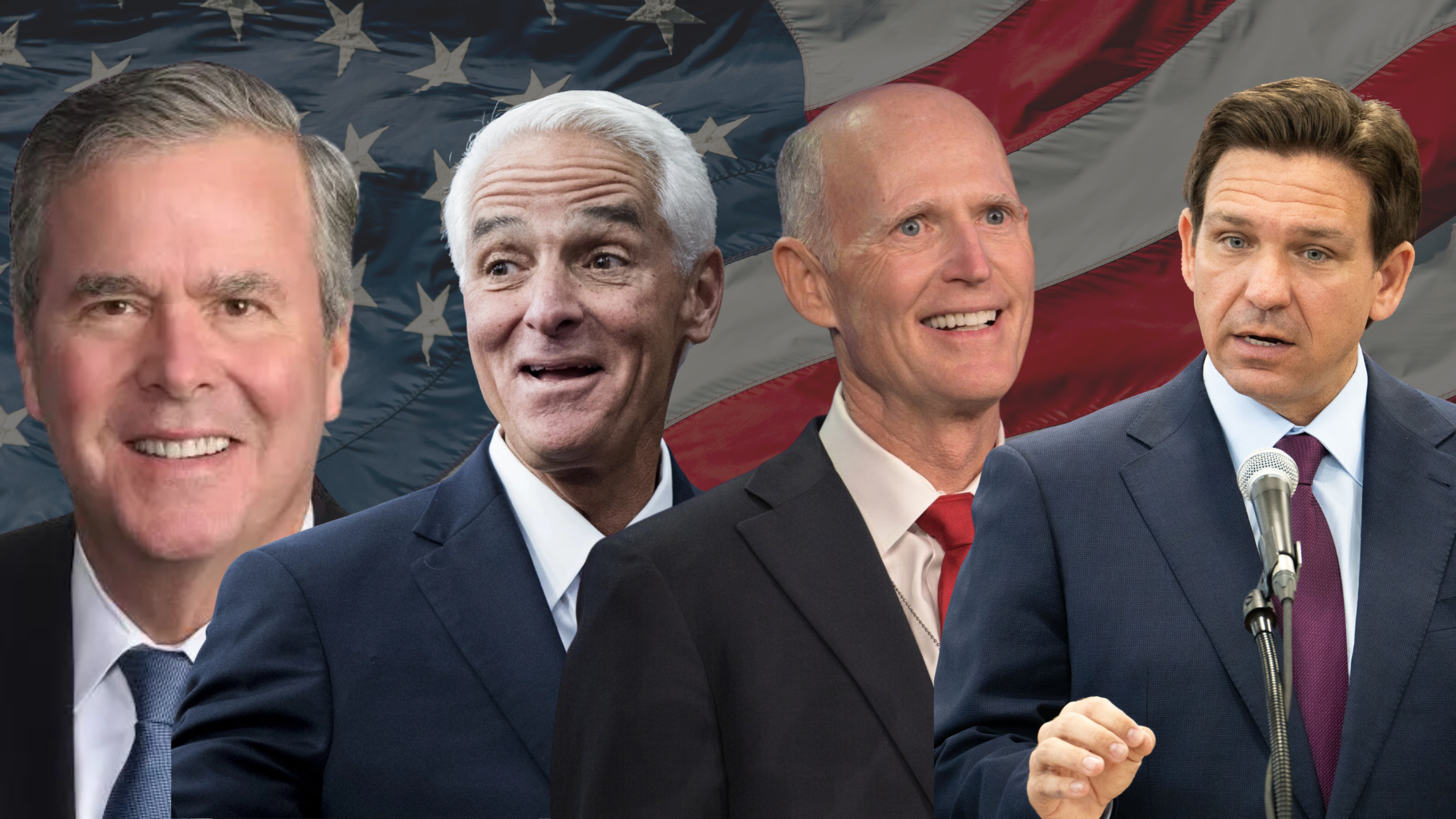
First in a four-part series on the 2026 Florida governor’s race. Part one, “Twenty Years, One Chair,” is how Florida got here. Part two, “The DeSantis Inheritance,” is the record the next governor takes over. Part three, “The Field and the Data,” is the candidates and the numbers. Part four, “Run, Byron, Run,” is the reckoning on the Trump endorsement and what it means. A standalone companion, “First, and for Whom,” keys in on Byron Donalds’s historic first and the full race breakdown.
There is a chair in Tallahassee that decides more about the daily life of twenty-three million people than almost any other office in this country outside the White House. It signs the budgets and vetoes the bills. It appoints the judges and the university boards. It draws its hand across the maps. It decides whether the state expands health care, how it treats an immigrant, what a child is allowed to read, and who gets protected when the water rises. In 2026, for the first time in eight years, that chair comes open, and the fight to fill it is the most revealing thing happening in American politics right now. To understand what is being decided, you have to understand how Florida got here, because this race did not begin in 2026. It began twenty years ago, in a series of moments that quietly set the course.
Why is this chair so powerful?
Before we walk the twenty years, understand why this one chair matters more than most. Not every governor is created equal, and Florida built one of the strong ones.
The Florida governor holds a line-item veto, the power to strike individual lines from a budget. He shapes the courts through the judicial nominating commissions he stocks. And right now, he sits atop a one-party government, the same party holding the governorship, both chambers of the Legislature, and the Cabinet, which means the checks that are supposed to slow an executive down have mostly been switched off.
I did not fully understand how unusual that was until I moved to North Carolina and went to work in its politics, where the arrangement is close to the reverse. North Carolina was the last state in the country to grant its governor a veto, and that did not happen until 1996. Even now, it is one of the weakest vetoes in the nation, with no line-item power, and a simple partisan majority in the General Assembly can override it. The Legislature is so dominant that the governor cannot even veto a redistricting map because the state constitution places the maps beyond his reach. And the people, not the governor, elect the state Supreme Court. Power in North Carolina is shared, split across branches and ballots on purpose, a habit the state kept from its old fear of kings.
Florida went the other way. It concentrated power in the chair. So when you decide who sits in it, you are not filling a ceremonial office. You are handing one person a budget knife, a bench, and a machine, with very little standing in the way in a one-party state. That is the prize. Here is how it was built.
Before the fortress: the last Democrat
To measure how far the chair has moved, start with the last Democrat who ever sat in it. Lawton Chiles, a plain-spoken former United States senator who once walked the length of the state on foot and was nicknamed “Walkin’ Lawton,”served as governor from 1991 to 1998. In 1994, he beat a young Jeb Bush by a hair, 50.8 percent to 49.2, about a point and a half, the last time a Democrat won this office. Chiles is also the governor who took Big Tobacco to court and won Florida billions in the landmark settlement that followed. He died in office in December 1998, weeks short of the end of his term, and his lieutenant governor, Buddy MacKay, served out the final days of his term. No Democrat has held the chair since. That is the ground against which this whole story is measured. Florida was a Democratic state within living memory, and one chair, across twenty years, is a good part of how it stopped being one.
The Bush machine and the boy in the locker room
I can tell you the year it started, because I was there for it. It was 1999. I was in the tenth grade, suiting up for football in the locker room at Coral Reef Senior High School, newly minted as Miami’s Mega Magnet, when a slim man walked in. The room smelled the way those rooms always smell: cut grass, tape, and pads that never fully dry. I was fifteen and a half into my jersey, and I watched him work the room with the easy smile of a man who already knows how the vote comes out. I did not know I was looking at the man who would turn Florida from a Democratic state into a Republican fortress. You never do. Power walks past you in a locker room, and you go back to lacing your cleats, and it takes twenty years to understand you were standing in the room where it started. The man was Jeb Bush, son of a one-term president, brother of the man about to become the next one, and he was about to remake my state for a generation.
He had lost once already, a narrow defeat in 1994 to the Democrat Lawton Chiles. He came back in 1998, won, and became the first Republican governor in Florida history to be reelected. And he governed like a man who intended to change the place at the root.
His signature was education, and this is where the story bends back to me. Bush built the A+ Plan, a mandatory A-to-F grade for every school and an end to social promotion. Then he created Opportunity Scholarships, the nation’s first statewide school voucher program. He called it School Choice. Years later, I would write about Columba Bush, the governor’s wife, visiting Coral Reef to tour the very arts programs I had come up in, and the irony was almost too clean to be real. The First Lady of Florida, admiring the public arts programs that raised me, while her husband’s School Choice law was busy opening the door that would pull the money and the students out of schools exactly like mine. They came to be photographed with what public education built, and then they went to Tallahassee and governed against it. I have never forgotten the two faces of that image, the praise in one hand and the knife in the other.
And it did not stay in Florida. Bush’s brother, George W., took the model national, signing No Child Left Behind, the same accountability-and-testing logic scaled to the whole country. What Jeb built in Tallahassee became the template in Washington. And what it launched at home was bigger than any one policy. It was the beginning of more than twenty years of one-party rule in Florida, across all three branches, feeding a governorship that grew stronger every year. The chair I described at the top of this piece did not become a fortress by accident. Jeb Bush laid the first stone in the years I was a kid at Coral Reef, watching a slim man walk through the locker room.
Put the numbers to it. Bush won the office in landslides, 55 percent to 45 percent over Buddy MacKay in 1998, and 56 percent to 43 percent over Bill McBride in 2002, becoming the first Republican to serve two full terms as governor of Florida. The budget grew as the state’s population and housing market ran hot, and crime kept falling, though crime was falling all across America in those years, and no governor of either party gets to pin that on his own record. And there is a harder ledger to read alongside the wins. In 1999, Bush moved to end affirmative action in state university admissions and contracting with an executive order he called One Florida, and two Black legislators staged a sit-in in his office while thousands marched on Tallahassee in protest. A year later, his state decided a presidential election by 537 votes and made his own brother president, with Jeb sitting in the governor’s chair during the process. The machine he built was not only political. It was personal and national, and it started at home.
The man who crossed every aisle
Then came Charlie Crist, and Crist is the whole story of Florida’s churn in one man. He won the chair in 2006 as a Republican, 52 percent to 45 over the Democrat Jim Davis, a sunny, moderate, back-slapping Republican who governed toward the center and, in 2009, literally embraced Barack Obama on a stage over the federal stimulus, a hug he never lived down with his own party.
Then the ground moved under him, and this is where the history stops being abstract for me, because I worked it. In 2010, boxed out of the Republican Senate primary by a rising conservative named Marco Rubio, Crist left his own party and ran for the United States Senate as an independent. The Democratic nominee in that race was Congressman Kendrick Meek, the son of Carrie Meek, one of the three who broke the 116-year silence in 1992, and I volunteered for him. I knocked on doors in that race because Kendrick Meek and his mother, Carrie, were not abstractions to South Florida. They were the family that had carried our voice to Washington when almost nobody else would. So I took it personally, watching the vote split three ways and the seat slide out of our hands. That is where I learned, in my own feet and my own gut, what a divided field costs a community. It is a lesson that has never once left me. What happened was the oldest tragedy in politics. Rubio, Crist, and Meek split the field three ways, and Rubio walked straight up the middle to win with about half the vote, while Crist took roughly 30 percent and Meek roughly 20 percent. Bill Clinton reportedly urged Meek to drop out so the vote could consolidate behind Crist and stop Rubio. Meek refused and said plainly that he was not going anywhere but the Senate. The split held. Rubio went to Washington, where he sits in power to this day. If the fear that runs all through my congressional reporting, the fear of a divided field handing a seat away, has a birthplace in my own life, it is that 2010 race.
Crist was not finished crossing the map. He became a Democrat, ran for his former governor’s chair in 2014 and lost to Rick Scott by a single point, then ran again in 2022 and lost to Ron DeSantis by nearly 20 points. One man, three parties, a governorship, a Senate bid, and two comeback defeats. If you want a picture of how unsettled Florida politics was before it hardened into one-party rule, it is Charlie Crist, walking from party to party while the ground set like concrete under his feet.
The austerity years
Rick Scott took the chair in 2011, and he took it as something new: a health care executive worth a fortune, a man who had never held office, elected on the Tea Party wave by the thinnest of margins, 48.9 percent to 47.7 over the Democrat Alex Sink, a little more than one point. He had run the hospital giant Columbia/HCA, which paid a record federal fine for Medicare fraud during his time there, and he brought a chief executive’s eye to the state and ran it like a balance sheet. He cut taxes and regulations, made “Let’s get to work” his brand, and the job numbers and the budget climbed with the recovery.
The other side of the ledger is who got left out. Scott rejected $ 2.4 billion in federal funding for a Tampa-to-Orlando high-speed rail line, a stance Tallahassee would maintain on transit for years afterward. He fought the Affordable Care Act’s Medicaid expansion, leaving hundreds of thousands of low-income Floridians without coverage that the federal government had offered to pay for. He signed a law to drug-test welfare applicants that the courts later struck down. He won a second term in 2014, again by a single point, this time over a familiar face, Charlie Crist, now running as a Democrat. And when his eight years were up, Scott did not go home either. He defeated sitting United States Senator Bill Nelson in 2018 and went to Washington, where he sits today. The chair he left behind was about to be decided by the closest and most consequential margin in modern Florida history.
The hinge: 2018
Here is the moment the whole era turned, and it turned by a third of a percent.
In 2018, a young Black mayor named Andrew Gillum, the first Black major-party nominee for governor in Florida history, ran against a little-known congressman named Ron DeSantis, and came within about 0.4 percent, roughly 33,000 votes out of more than 8.2 million, of winning. Sit with how close that was. Thirty-three thousand votes in a state of that size is a rounding error. It is a bad afternoon of turnout in two counties. And on the far side of that rounding error sat two completely different Floridas. One where a Black progressive from Tallahassee sets the state’s course for the next decade. One where a Trump-aligned conservative does. The margin chose the second, and everything that has happened since- the maps, the school fights, the national ambitions- all of it flows through that single, razor-thin result.
I remember what that night did to me, watching the margin close and then refuse to close the last inch—a third of a percent. I had given years to the machinery that was supposed to make nights like that end differently, and I sat with the number the way you sit with a diagnosis. A decade of my state’s direction, the maps, the schools, the crackdown, all of it decided by a margin thinner than a bad afternoon of turnout in two counties. I have carried that number ever since, and it is a large part of why I write about Andrew Gillum the way I do.
The era that followed
The governor who gave 0.4 percent to Florida did not govern like a man who barely won. Ron DeSantis took the chair in 2019 and used it to remake the state and to build a national brand at the same time. He was reelected in 2022, and this time it was not close: 59 percent to 40, nearly 20 points, a landslide over the same Charlie Crist, who had already been governor once. He turned Florida into the laboratory and the flagship of a national movement, ran for president in 2024 on that record, and came back to finish a second term that term limits will not let him extend.
Set the two ledgers side by side, because Part Two will hold them up in full. On one side, the numbers his supporters will cite: unemployment around 2 percent, a state budget that has climbed past 115 billion dollars, up from roughly 48 billion when Bush first took the chair, and a crime rate that sits near historic lows, though crime has been falling in Florida for fifty years, under Democrats and Republicans alike, and no one governor can claim it. On the other side, the costs your readers live with: the maps redrawn to thin Black political power, the fights over what a child can read, the immigration crackdown, and a governor who spent a chunk of his second term running for another office. Twenty years, five governors, one direction. That is how Florida got here.
Whatever you think of what he built, Part Two of this series will hold it up fairly and in full; one fact is not in dispute: for eight years, the direction of this state has been set by one man, and in January 2027, that man has to leave. The chair comes open. And the fight to fill it is not a normal succession.
What is at stake in 2026
So here is what this race is actually deciding, and why it is worth four parts and not one.
It is deciding the direction of one of the three or four most important states in the country, an open governorship in a place that picks presidents, at a moment when the term-limited governor will not hand the chair to his own party’s frontrunner. The president of the United States has reached into the state to choose the successor himself. It is being decided whether the DeSantis project will extend for another eight years or finally reach its limit. For the Florida I come from, the working, the Black, and the Brown of South Florida, this open chair is not a horse race. It is whether the next decade is done to us or built with us. Whoever sits in it will sign the budgets that fund or starve our schools, draw or spare our districts, protect or hunt our neighbors. That is what is actually on the table, under the names, the ads, and the noise.
And it is deciding something specific and uncomfortable for Black Florida, which the rest of this series will sit with honestly. The Republican nominee, now favored to make history and become the first Black governor of a state that has treated Black people the way this one has, is Byron Donalds, the standard-bearer of the very movement that spent the DeSantis years thinning Black political power. The Democrat who won the nomination to face him is David Jolly, a former Republican congressman. In the race to lead one of the Blackest and Brownest states in America, that is the choice on the table, and it did not come from nowhere. It came from twenty years in that chair, and from one night in 2018 when the whole thing turned on 33,000 votes.
So I keep coming back to the chair, and to the boy in the locker room who did not know what he was looking at. A governorship is not a trophy. It is a budget knife, a bench, and a machine, handed to one person in a state that has learned to decide everything by margins this thin. The question the next three parts chase is the only one that finally matters. When the most powerful chair in Florida opens, who is it actually going to serve, and who is going to be left, once more, holding less than they started with?

Denzel D. Burnside III is a Miami-Dade native, a minister, and a former organizer and campaign manager. He is the founder and executive director of the North Carolina Housing Table, a statewide housing coalition, where he works on housing and transportation policy.
Hy-Lo News encourages community members, thought leaders, social commentators, experts, and really ANYONE to submit commentary expressing their opinions and sharing their points of view. The views they express in their Op-Eds are their own, but we believe in the right to provide people a platform to share them. However, we will never condone or publish hate speech, violence, bullying, or anything our editorial team deems problematic.
To submit your Op-Ed, email us at info@hylonews.com.
0 comments on “OP-ED | Twenty Years, One Chair: Florida’s Republican Reign and What the 2026 Governor’s Race is Really Deciding”