

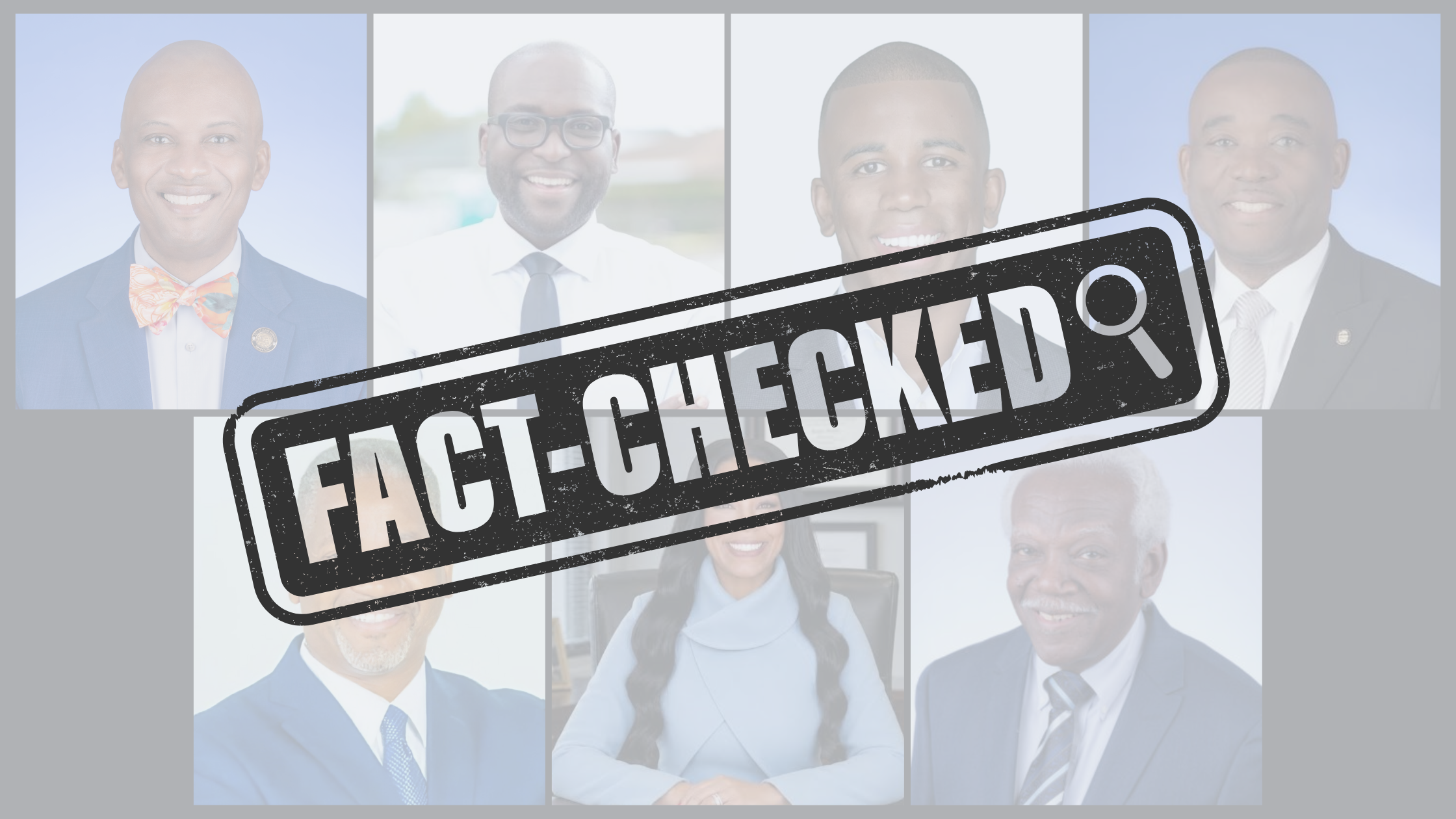
They sounded good. That is not the same as being right. Here is every major claim from the NAACP forum, checked against the record, plus the one flatly false statement of the night.
Third in a three-part series on Florida’s 24th Congressional District. Part one covers what is at stake. Part two covers who showed up.
An operative who will not check the receipts is just a fan. So I went back through the June 30 forum at Florida Memorial University claim by claim, and I checked them against the law, the budget, and the record.
The context, briefly. Seven candidates are running to replace the retiring Frederica Wilson in Florida’s 24th, a majority-Black district and one of only two Black-performing seats left in Florida. Six Democrats (Oliver Gilbert III, Shevrin Jones, Kendrick Meek Jr., Jean Monestime, Marshall Davis Sr., and Rod Vereen) and one Republican (Te Mayonna Brown) took the stage. The primary on August 18 will effectively decide the seat.
Most of what these candidates said was true. Some of it was true but impossible, which is its own kind of problem: a promise Congress has no legal power to keep is not a plan, it is a mood. And two claims crossed the line into false or unproven, so let me put those at the top where nobody can miss them.
The false one. Te Mayonna Brown claimed the Southern Poverty Law Center was caught at a Senate hearing giving “KKK money to Democrats.” There is no credible basis for this. It is false, and I will not launder it by repeating it neutrally.
The unproven one. Kendrick Meek Jr. charged that a rival’s super PAC took $70,000 from a contractor tied to the Everglades detention site nicknamed “Alligator Alcatraz.” I could not verify it. Treat it as an accusation, not a fact, until someone produces the paperwork.
Everything else, question by question, below. For each one I lay out four things: the history almost nobody explains, who was right and who was wrong, what could actually fix it, and what it will take to get there.
Minimum wage
“Do you support raising the federal minimum wage, and if so, to what level?”
The history: The federal minimum wage has been stuck at $7.25 since 2009, the longest stretch without a raise since Congress created the wage floor in 1938. Florida voters got tired of waiting and passed Amendment 2 in 2020, which walks the state wage up to $15 this September on its own.
Who was right, who was wrong: Jones was right, and specific. Brown was fencing with a ghost; nobody, in Tallahassee or Washington, has proposed $25, and Florida’s $15 is already law, not a threat. The small-business squeeze she described is real, but the number she attached to it was invented.
What could work: Expand the federal Earned Income Tax Credit, which lifts low-wage workers without hitting a corner-store payroll; smooth the benefits cliff so aid tapers instead of vanishing; and pair any raise with a small-business tax credit.
What it will take: A Raise the Wage Act has passed the U.S. House before and died in the Senate. Nothing here moves without 60 Senate votes, which is why the cliff fix and the EITC, both doable through the tax code, are the realistic near-term wins.
The cost of living
“With groceries and gas still high, what would you do to bring down the cost of living?”
The history: The inflation that gutted family budgets after 2021 came mostly from tangled supply chains, energy shocks, and a housing shortage, not from any single president’s spending line. Prices have since cooled, but wages never fully caught up, which is why it still feels like drowning.
Who was right, who was wrong: Gilbert was right that tariffs land on consumers as higher prices. The candidates who reduced the whole thing to “a spending problem” or “Trump’s wars” were reaching for a bumper sticker, not an answer. Meek at least named levers.
What could work: A federal gas-tax holiday is real but small, about 18 cents a gallon, and retailers pocket some of it. The bigger levers for this district are childcare subsidies, which matter enormously where so many households are led by a single mother, real price-gouging enforcement at the FTC, and, above everything, housing.
What it will take: Most of this is not a member’s solo call; the Federal Reserve, not Congress, steers inflation. But childcare funding and an expanded Child Tax Credit are appropriations fights a determined member can actually join.
Housing, the whole ballgame
“What is the single most important thing Congress could do in the next two years to make housing affordable?”
The history: Greater Miami is the most rent-burdened metro in America. Roughly six in ten renters are cost-burdened, and a two-bedroom’s fair-market rent jumped about 21 percent in a single year. Florida’s own answer, the Live Local Act of 2023, throws state money and zoning overrides at the problem to force more building, and it also bans cities from passing rent control.
Who was right, who was wrong: Meek and Jones were on the money. Vereen was wrong on a fact (Florida is expensive but not the single most expensive state; Hawaii, California, Massachusetts, and New York rank higher) and wrong on a fix (federal rent caps are a legal and economic dead end, and Florida law already forbids local rent control). Monestime’s heart is right, but a federal 3 percent mortgage cap is not something Congress can or will do.
What could work: Expand the LIHTC through the bipartisan Affordable Housing Credit Improvement Act; scale up down-payment help modeled on Florida’s Hometown Heroes program; reform FHA to widen first-time-buyer access; and use the tax code to curb Wall Street’s bulk-buying of single-family homes, a documented driver of price in Black neighborhoods.
What it will take: The LIHTC expansion is genuinely bipartisan and has ridden past tax packages, which makes it the most winnable housing fight on the list. The investor-curb and tenant-protection pieces are harder and will need either a Democratic majority or a tax-bill trade.
The rapid-fire rounds
The lightning round. Yes or no on each: extend Haitian TPS, cancel student debt, expand background checks, legalize marijuana, protect abortion, pass Medicare for All, codify same-sex marriage, impose term limits, keep funding Israel, privatize Social Security.
The history: Haitian TPS is not abstract here; this district holds one of the largest Haitian communities in the country, and Wilson herself fought to extend it. Student-debt cancellation is popular but bruised, since the courts struck down the Biden mass-forgiveness plan. Background checks poll around 90 percent and have passed the House before.
Who was right, who was wrong: This is less about right and wrong than about a values line, and Brown drew hers clearly. The place to keep everyone honest: “cancel all student debt” runs straight into the same courts that killed the last attempt, so promising it wholesale oversells what a House member can deliver.
What could work: Extend and re-designate Haitian TPS through DHS; pursue targeted debt relief (public-service forgiveness, income caps, a bigger Pell Grant) that can survive a courtroom; and pass universal background checks.
What it will take: Almost all of it runs through the Senate filibuster. TPS is the exception, since it is an executive action a member can press the administration to take.
Education and book bans
“Given Florida’s book bans, do you support federal minimum standards for what schools can and cannot teach?”
The history: Florida became the national test lab for classroom censorship, from the Stop WOKE Act to a wave of book removals. But here is the catch nobody mentioned: for decades, federal law has barred Washington from dictating a national curriculum.
Who was right, who was wrong: Jones’s teacher biography checks out, and his instinct is sound. But the candidates who promised “federal minimum standards” on content, Meek and Gilbert included, were promising something the law does not let Congress do directly. Not wrong in spirit; wrong in mechanism.
What could work: Attach conditions to the federal school dollars districts already receive, fund the lawsuits that fight censorship, and use civil-rights enforcement to protect teachers and students.
What it will take: Funding conditions ride on appropriations and can move with a majority. The litigation route does not wait on Congress at all, which is part of why it is the faster lane.
HBCUs
“What federal investment would you prioritize for community colleges and HBCUs like Florida Memorial?”
The history: The shortchanging is documented, not rhetorical. In 2023 the U.S. Departments of Education and Agriculture showed that states had underfunded their land-grant HBCUs by more than $12 billion over three decades. Florida A&M alone was shorted about $1.9 billion. It traces back to the 1890 land-grant system, where states were supposed to fund Black colleges on par with white ones and simply did not.
Who was right, who was wrong: Jones was right and precise. Vereen’s vision is morally serious but legally cornered; race-based free tuition would collide with the same equal-protection reasoning the Supreme Court used to end affirmative action in 2023.
What could work: Fully fund Title III (the dedicated HBCU stream), expand the HBCU Capital Financing Program, and raise the Pell Grant, the single largest aid source for HBCU students.
What it will take: These are appropriations and reauthorization fights, winnable in pieces even in a divided Congress, especially the Pell increase, which has drawn bipartisan support before.
Dark money
“How would you deal with dark money and the flood of cash unleashed by Citizens United?”
The history: The modern money era opened with Citizens United in 2010, which let outside groups spend without limit. The 2026 ruling went a step further, lifting the cap on how much a political party can spend in coordination with its own candidates. It did not create “unlimited PAC money” (super PACs were already uncapped), and it cuts for both parties.
Who was right, who was wrong: The candidates were right that the ruling matters, but loose on what it did. Two claims cross from loose into false or unproven. Brown’s assertion that the Southern Poverty Law Center was caught giving “KKK money to Democrats” at a Senate hearing has no credible basis; it is false, and I will not launder it. Meek’s charge that a rival’s super PAC took $70,000 from a contractor tied to the Everglades detention site nicknamed “Alligator Alcatraz” is an unverified accusation; treat it as such until someone shows the paperwork.
What could work: The DISCLOSE Act, which would force dark-money groups to name their donors, is the actual bill everyone was circling and nobody named.
What it will take: Disclosure needs 60 Senate votes and has fallen short before. Reversing the Court’s money rulings outright would take a constitutional amendment, which is a decade-long project, not a first-term promise.
The property-tax amendment (Amendment 3)
An audience question: “Do you support the property-tax amendment on this November’s ballot?”
The history: This is a DeSantis project, passed by the Legislature in a June 2026 special session and sent straight to voters. It raises the homestead exemption from $50,000 to $150,000 in 2027 and $250,000 in 2028, zeroing out non-school property taxes for about 60 percent of homesteaded owners, with a path toward full elimination.
Who was right, who was wrong: Gilbert’s “essential versus non-essential” framing is precisely accurate: the measure shields public safety and pays for the cut out of everything else. Nobody on the panel misstated it. The disagreement here is honest, and it is about values, not facts.
What could work: Monestime’s idea, a targeted exemption for seniors and the disabled funded by a levy on homes worth more than $2 million, was the most surgical answer on the stage, since it protects fixed-income homeowners without gutting local budgets.
What it will take: This one is not decided in Washington. It needs 60 percent of Florida voters on November 3 to pass. The independent fiscal analysis pegs the hit to local budgets at $4.6 billion to $8.4 billion a year, which is the number every voter should weigh.
Teacher retention
An audience question: “How would you keep good teachers in the classroom?”
The history: Every model floated here is real. Hometown Heroes is an existing Florida down-payment program. The “Teacher Next Door” idea descends from HUD’s Good Neighbor Next Door, which sells eligible homes at half price to teachers, police officers, and firefighters in targeted areas. The COPS program, from the 1994 crime bill, had Washington pay part of local police salaries.
Who was right, who was wrong: Nobody was wrong here, which is worth saying, because it was the one round where the candidates traded slogans for buildable ideas. Jones’s point targeted the actual attrition data, which shows teachers quitting most in their first three years.
What could work: All of the above, plus federal grants that reward districts that raise starting pay.
What it will take: These are appropriations, meaning a member has to win them in the annual budget rather than pass one grand bill. Unglamorous, but achievable, and exactly the kind of delivery this seat has a history of.
The Metrorail North Corridor
An audience question: “After 20 years of broken promises, what will you actually do for the Metrorail North Corridor?”
The history: In 2002, Miami-Dade voters approved a half-penny sales tax, the People’s Transportation Plan, on the promise of up to 89 miles of new Metrorail, starting with a North Corridor line up NW 27th Avenue through Miami Gardens and Opa-locka to the Broward line. The tax has since raised more than $3.7 billion. The North Corridor was never built. Beginning around 2008, county leaders diverted roughly $100 million a year from the fund to plug operating budgets, and the federal government kept rating the heavy-rail plan poorly on cost and ridership.
Who was right, who was wrong: Gilbert was right on the substance, and it is not just talk. As chair of the county’s Transportation Planning Organization, he sponsored the move to a leaner, phased line and pushed to raise the requested federal share to 60 percent. Heavy rail really is the most expensive option, and bus rapid transit really does score better for federal grants. Vereen was right that the money was raided, though pinning it on one former mayor oversimplifies a diversion that spanned administrations. Jones flubbed the scale (“300 billion” when he meant million), but his core point held: Tallahassee, not Washington, has been the chokepoint.
What could work: Fund a bus-rapid-transit line through the FTA’s Capital Investment Grants program rather than chasing a billion-dollar-a-mile heavy-rail dream that keeps failing the federal math.
What it will take: A member who will shepherd the grant application, hold the state’s feet to the fire on its share, and resist the temptation to over-promise rail the county cannot finance. In other words, exactly the kind of federal-plus-local coordination this job exists to do.
The tally
Counting only the claims I could actually adjudicate as true or false (the yes-or-no values rounds are opinions, not facts), here is how the field scored on accuracy:
| Candidate | Roughly right | Accuracy |
|---|---|---|
| Shevrin Jones | 6 of 7 | ~86 percent |
| Oliver Gilbert III | 4 of 5 | ~80 percent |
| Jean Monestime | 2 of 3 | ~67 percent |
| Kendrick Meek Jr. | 4 of 7 | ~57 percent |
| Rod Vereen | 2 of 4 | ~50 percent |
| Te Mayonna Brown | 1 of 3 | ~33 percent |
Marshall Davis Sr. is the asterisk. He drew no false flags, but he also made the fewest hard, checkable claims, so a percentage would flatter him for staying general. Call it clean but light.
Two honest caveats, because I would rather you trust this than be impressed by it. The denominators are small and uneven, so read these as directional, not scientific. And this measures factual accuracy only. It does not measure who had the best ideas, the best values, or the best chance of delivering. A candidate can be right about everything and still be unable to move a single bill.
Which is the whole point of the exercise. In a district this fragile, the question is not who sounded the most certain on a Tuesday night. It is who told you the truth about what the job can actually do.
(Sourcing and data: the U.S. Supreme Court (Louisiana v. Callais; NRSC v. FEC); the U.S. Departments of Education and Agriculture (2023 HBCU land-grant funding analysis); the Florida Legislature and the Tax Foundation (Amendment 3); the Florida Department of Commerce (minimum wage); the U.S. Census Bureau, Apartment List, HUD, and Miami Homes for All (rent-burden and housing data); the FTA Capital Investment Grants program and HUD’s Good Neighbor Next Door program; Miami-Dade County records on the People’s Transportation Plan; and reporting from the Miami Herald, WLRN, CBS Miami, Florida Politics, the Miami Times, and Roll Call. Candidate statements reflect the June 30, 2026 Florida Memorial University forum. The primary is August 18, 2026.)

Denzel D. Burnside III is a Miami-Dade native, a minister, and a former organizer and campaign manager. He is the founder and executive director of the North Carolina Housing Table, a statewide housing coalition, where he works on housing and transportation policy.
Hy-Lo News encourages community members, thought leaders, social commentators, experts, and really ANYONE to submit commentary that expresses their opinion and shares their point of view. The views they express in their Op-Eds are their own, but we believer in the right to provide people a platform to share them. However, we will never condone or publish hate speech, violence, bullying and anything our editorial team deems problematic.
To submit your Op-Ed email us at info@hylonews.com.
0 comments on “OP-ED | Fact-Checking the Forum: What Florida’s 24th Candidates Got Right, and What They Made Up”