

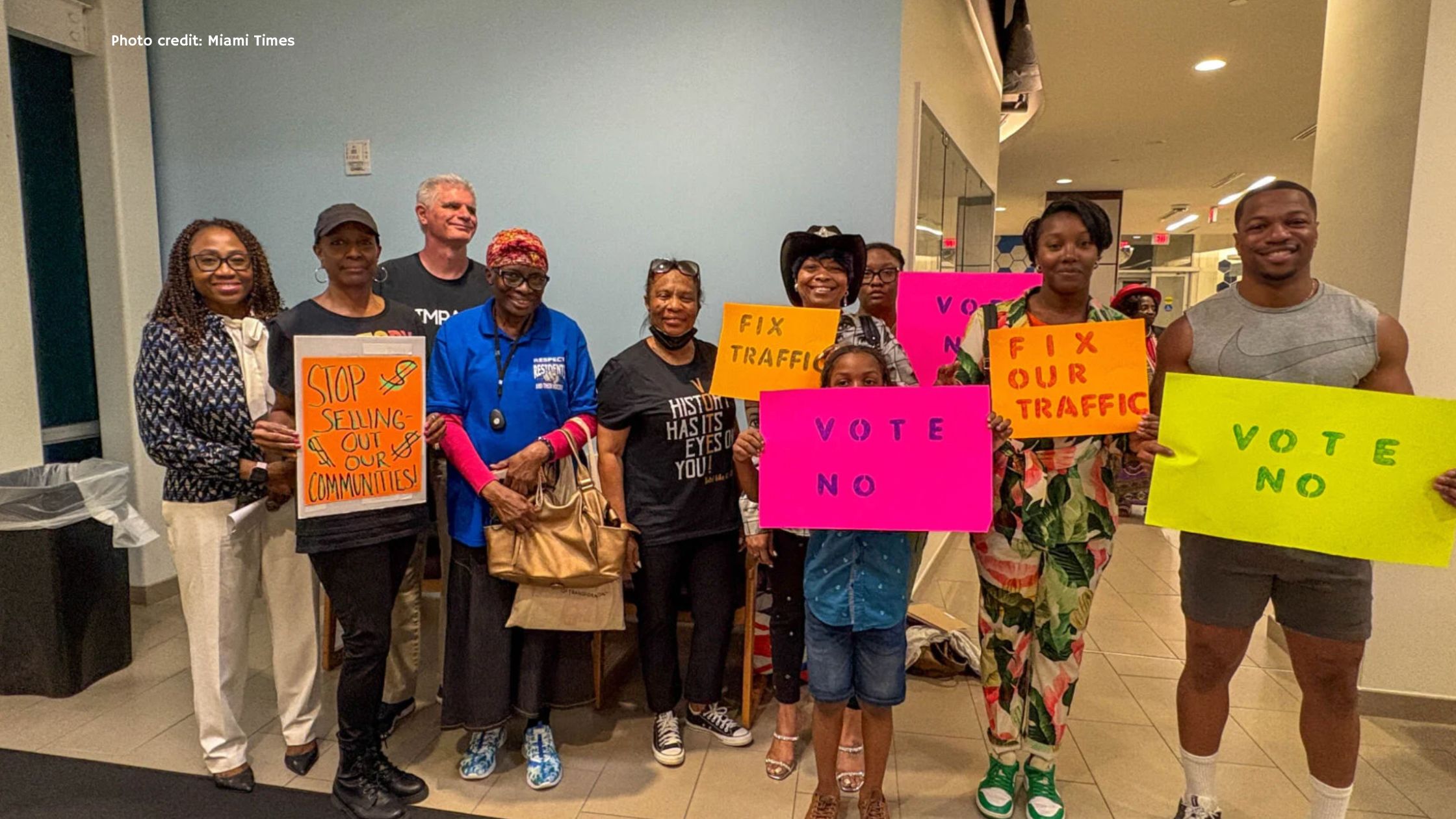
In a major win for environmental justice and community organizing, residents of Miami Gardens successfully blocked a controversial rezoning plan last Wednesday. The City Council voted 4-3 to deny El Dorado Furniture’s request to convert a 4.21-acre residential parcel near Venetian Gardens into a heavy industrial site.
The decision, first reported by The Miami Times, followed weeks of grassroots mobilization led by locals who refused to let corporate expansion compromise their quality of life.
The hearing was marked by deeply personal testimony from neighbors who described the physical toll of living in an industrial “sandwich.” During the public comment session, Z Spicer, a resident and organizer with Catalyst Miami, challenged the council to breathe in the room’s filtered air and compare it to the reality outside.
“Imagine waking up one morning and seeing a sign saying that a residential area is going to be rezoned to heavy industrial,” Spicer testified. “I’ve lived by the Golden Glades Expressway for the past three years… I was calling off work, and I was bedridden because I could not stop sneezing and experiencing the dust that’s in my neighborhood”.
Spicer raised a fundamental question of agency: “Do the residents of Venetian Gardens have the say of what happens in their neighborhood, or is any business able to come in, put together a PowerPoint, and decide what the road looks like despite not living there?”
Local organizer Myya Passmore led the room in a standing show of solidarity, emphasizing that the community is already facing public health threats from the airport, the highway, and existing industrial districts.
“No traffic study has been done, and that’s it,” Passmore told the dais. “It comes off a bit biased because they’re doing their own study saying what won’t happen… If you’re not tracking that stuff and you’re just giving a nice PowerPoint, how are we really assessing how this will impact us?”
The scientific weight of these concerns was bolstered by Dr. Cheryl Holder, former medical director of North Dade Health Center. “Where you live, work, and play is more impactful for your health than your DNA,” Dr. Holder explained. She warned that truck diesel exhaust releases $PM_{2.5}$—tiny particles that bypass the body’s natural filters.
“It gets into children’s lungs… increases the risk of asthma, lung disease, heart, and then cancer. The data is very clear,” Dr. Holder noted, citing causality between this specific type of industrial pollution and long-term health decline in Black communities.
For many, the rezoning felt like a missed opportunity to address the city’s housing crisis. Keisha Gayton, a resident of 53 years, questioned the equity of the proposal.
“Our community already doesn’t have enough inventory for housing,” Gayton argued. “To take up a space for profit over people is very dismaying for me. I want to know what equity have they [El Dorado] put into our community? They’ve been there over 50 years”.
Lynette Hickenbottom, a 73-year-old two-time cancer survivor, brought her medications to the podium to demonstrate the daily reality of living with poor air quality. “This is my survival every day,” she said, urging the council to prioritize people over “nice PowerPoints.”
The debate turned personal when Councilman Reggie Leon challenged his colleagues to protect the community’s right to breathe. When Leon pushed to delay the vote for air quality testing, Councilwoman Katrina Wilson objected, arguing that businesses shouldn’t be penalized if they’ve complied with existing laws.
“Don’t put any residents on me,” Wilson fired back during a heated exchange, asserting that a comprehensive study was needed rather than stopping a specific project. Ultimately, the motion to delay was withdrawn, leading to the final 4-3 vote that killed the project entirely.
The victory in Miami Gardens serves as a reminder for activists across South Florida that local government is the front line of the climate justice movement. As resident Keisha Gayton noted after the vote, the outcome proved a vital point for the community:
“The power of the people is greater than the people in power.”
With the administration’s term ending in December 2026, this vote sets a significant precedent for how Miami Gardens will handle industrial encroachment in residential neighborhoods moving forward.
Sign up for our weekly email newsletter and watch our weekly LIVE podcast news show every Thursday at 5:30pm. Subscribe to our YouTube page to get alerts for the show.
Do you have news to share? If so, send Hy-Lo News your story ideas by clicking HERE.
0 comments on ““The Power of the People”: Miami Gardens Residents Block El Dorado Warehouse Expansion Given Public Health Concerns”